Japan is Nippon
Toka Ebisu (Imamiya Ebisu Shrine, Osaka)
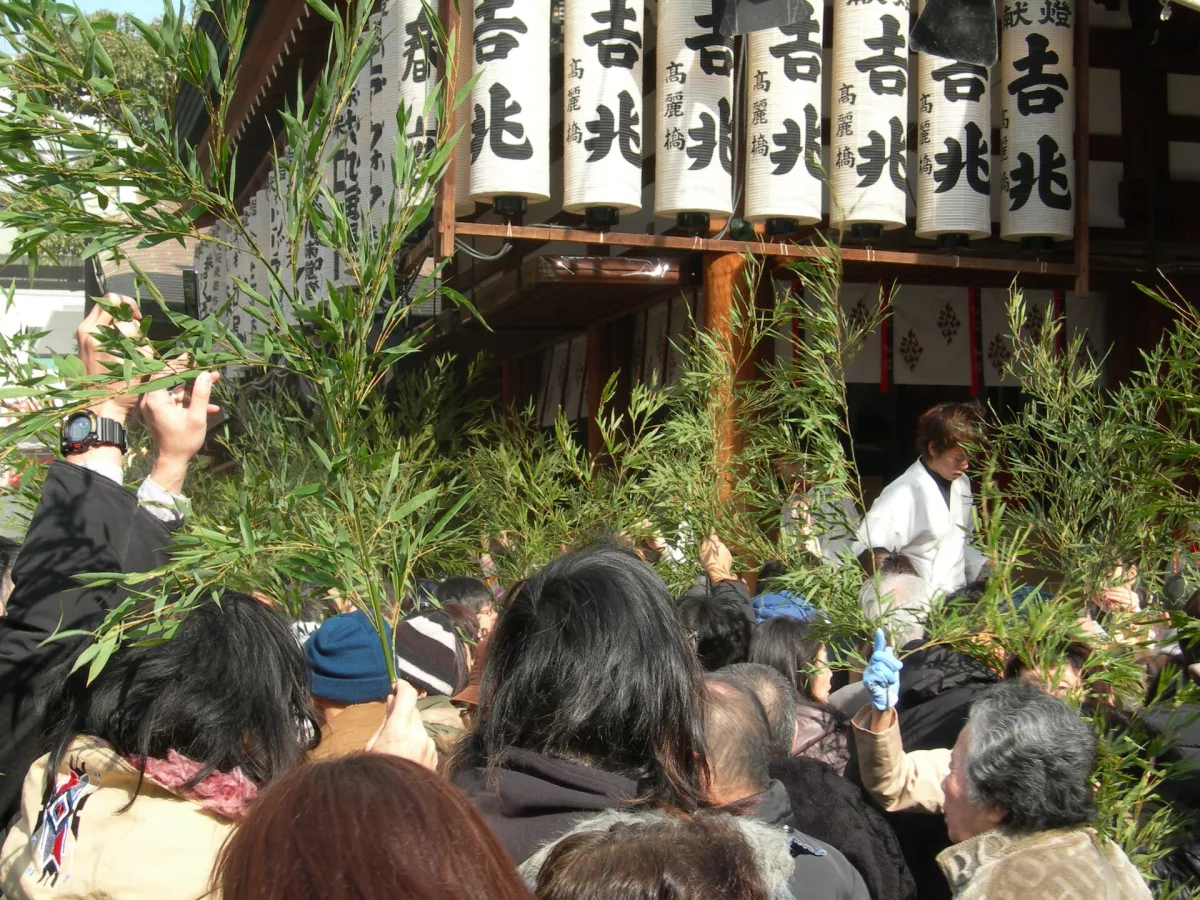
"Bring your bamboo for good business!" rings out as fuku-musume tie lucky charms to your branch: three days Osaka's merchants count on to start the year.
Osaka
- OsakaImamiya Ebisu Shrine, Naniwa ward, Osaka; the Hoekago parade on the 10th passes through Minami's busy streets such as Dotonbori
Recent years
| Year | Dates | Visitors | Notes |
|---|---|---|---|
| 2027 | 9–11 January | — | The dates are fixed at 9–11 January every year. |
| 2026 | 9–11 January | — | Fuku-musume chosen from 2,581 applicants served at the shrine. The Hoekago parade on the 10th saw a dozen or so palanquins and about 480 people process through Minami. |
| 2025 | 9–11 January | — | The Hoekago parade took place on the 10th, the coldest day of the winter so far. The shrine was open for worship 24 hours a day during the festival and closed its gates at 1am on the 12th. |
| 2024 | 9–11 January | — | The Hoekago parade, cancelled because of COVID-19, returned for the first time in four years, with 16 palanquins and about 500 people processing through Minami in light rain. |
When and where is it held?
Toka Ebisu ("Ebisu of the Tenth") is a festival held for three days, 9, 10 and 11 January every year, at Imamiya Ebisu Shrine in Naniwa ward, Osaka. The 9th is called Yoi Ebisu ("Ebisu Eve"), the 10th Hon Ebisu ("the main Ebisu day") and the 11th Nokori Fuku ("leftover luck", also Nokori Ebisu). The dates are the same every year regardless of the day of the week; the next one is Saturday 9 to Monday 11 January 2027 (a public holiday).
The deity enshrined here is Ebisu, the god of thriving business and good fortune, affectionately called "Ebessan" in Osaka. Ebisu is usually shown with a sea bream tucked under his left arm and a fishing rod in his right hand, and he is also a protector of fishermen and a bringer of the sea's bounty. Imamiya Ebisu Shrine is sometimes counted as one of Japan's three great Ebisu shrines.
In 2025 the shrine was open for worship 24 hours a day throughout the festival, and its gates closed completely at 1am on the 12th.
From god of a seaside market to god of Osaka's merchants
According to the shrine, tradition says Imamiya Ebisu was founded around the year 600, when Prince Shotoku built Shitennoji temple and enshrined the deity as guardian of its western side. The shrine used to stand close to the shore, and in the Heian period it supplied fresh fish to the imperial court. In the late Heian period a "beach market" grew up at Shitennoji's west gate, and Ebisu came to be revered as that market's guardian.
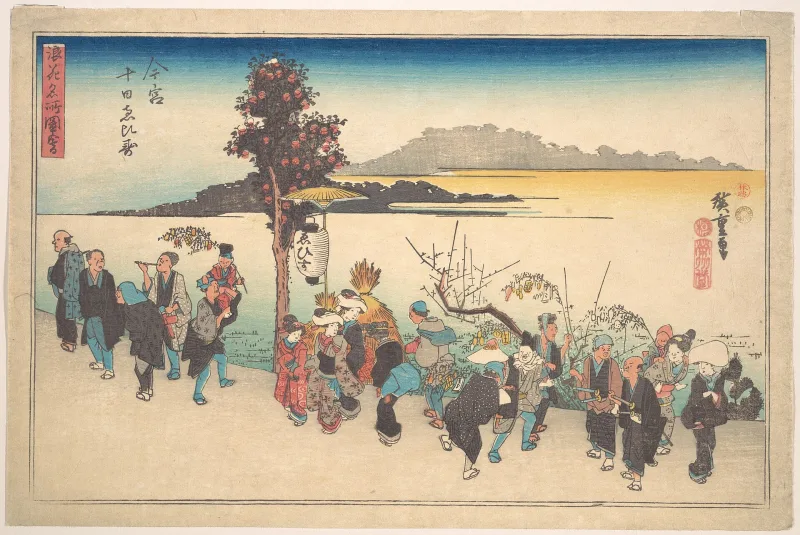
When Osaka flourished as a merchant city in the Edo period, Ebisu was devoutly worshipped as the protector of Osaka's trade, and Toka Ebisu grew lively too; it even appears on a 1675 guide map of Osaka. All the shrine buildings burned in the air raids of 1945, but the main hall was rebuilt in 1956, and today the festival is the first of Osaka's year, drawing worshippers from across the Kinki region and all over Japan.
Lucky bamboo, kitcho charms and fuku-musume
What worshippers carry home is a fukuzasa (lucky bamboo branch). According to the shrine, this is not the low-growing bamboo grass called sasa but a branch of moso bamboo, chosen to share in the vitality of bamboo, which stays green all year round. The lucky charms tied to it are called kitcho, and the shrine has long also called them kodakara ("little treasures"). They include gold coins, rice bales, sea bream, a magic mallet and a daifukucho (an Edo-period merchant's account book): decorations representing the bounty of the mountains, the sea and the fields.
The ones who tie the kitcho to your branch are the fuku-musume ("lucky maidens"). Dressed in matching kimono with a white chihaya (a shrine maiden's over-robe) and a golden eboshi (a tall court cap), they stand at the counters from 9am to 9pm on all three days. They are recruited from the public every year; in 2026, 44 were chosen from 2,581 applicants. When you receive your branch, they send you off with "Yo omairi deshita" (thank you for coming to pray).
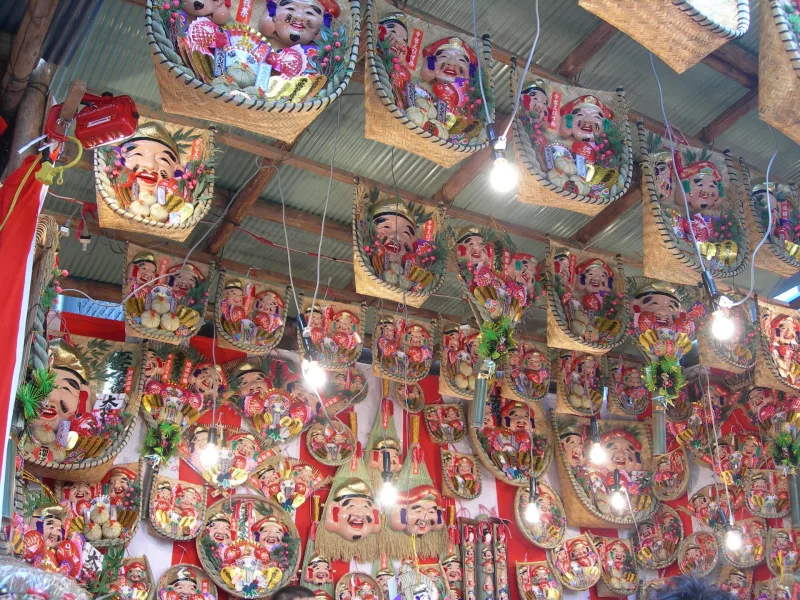
The chant "shōbai hanjō de sasa motte koi" (bring your bamboo for good business) plays the whole time in the shrine grounds. Large rake and basket decorations are also sold in and around the grounds, but according to the shrine these are sold by supporters' groups and street stalls and are not items given out by the shrine.
The Hoekago parade on the 10th
On Hon Ebisu, the 10th, comes the Hoekago parade: fuku-musume, actors, rakugo storytellers (traditional comic storytellers) and others ride in palanquins decorated with red and white cloth, processing through Minami's busy streets such as Dotonbori to the shrine to cries of "hoekago, hoekago". It began with the geisha of Minami visiting the shrine in a showy line of palanquins and is said to have continued for more than 200 years. The shrine says that at its peak, from the Meiji era to the early Showa era, as many as 100 palanquins lined up.
There is more besides. In the Edo period, the Zakoba fish market had a custom of offering a male and female pair of large sea bream every year on Yoi Ebisu, 9 January, and the people of Osaka Kizu Market, who carry on that tradition, still offer sea bream at Toka Ebisu. Related rites continue before and after, including rice-cake pounding on the 7th and a tea offering ceremony and bugaku (court dance) performance on the 8th.
Crowds and shrine manners
The three days are packed with worshippers. According to the shrine, prayer ceremonies cannot be booked during the festival, items from the shrine can only be paid for in cash, and no discounts are given under any circumstances (because the items carry the spirit of the deity). Pets are not allowed in the grounds.
The basic way to pray is "two bows, two claps, one bow": bow deeply twice, clap your hands twice, and after praying, bow once more. Last year's lucky bamboo can be returned at any time of year to the kosatsu osamesho (old-talisman return point) in the grounds.
Tips
- Fukuzasa (lucky bamboo branches) are only given out during the three days of Toka Ebisu. The kitcho charms (decorations such as gold coins and rice bales) are available at other times too.
- Items from the shrine can only be paid for in cash. Bring small change and things go more smoothly.
- To see the Hoekago parade, head to the Dotonbori area on the morning of the 10th. Fuku-musume and celebrities wave to the crowds from their palanquins.
- Big rakes and similar items are sold by stalls and cannot be returned to the shrine. Return the bamboo branches and talismans you received from the shrine to the kosatsu osamesho (old-talisman return point).
- Prayer ceremonies cannot be booked during the three days of Toka Ebisu (they are accepted as you arrive). On 7 and 8 January, prayer ceremonies are not held at all because of related rites.
Sources
- 今宮戎神社「十日戎」 (opens in a new tab)
- 今宮戎神社「今宮戎神社とは」 (opens in a new tab)
- 今宮戎神社「福娘について」 (opens in a new tab)
- 今宮戎神社「よくあるご質問」 (opens in a new tab)
- 今宮戎神社「参拝のご案内」 (opens in a new tab)
- デイリースポーツ「『商売繁盛で笹持ってこい!』大阪・今宮戎神社の『十日戎』賑わう」(2025年) (opens in a new tab)
- 産経ニュース「『十日戎』が幕開け、福笹手にご利益求め 今宮戎神社」(2026年) (opens in a new tab)
- 産経ニュース「宝恵かご行列、福娘や俳優を乗せ華やかに 大阪・ミナミの新春行事」(2026年) (opens in a new tab)
- 朝日新聞「今宮戎神社の福娘、十日戎をPR」(2026年) (opens in a new tab)
- 朝日新聞「神様えべっさんに商売繁盛願う 大阪・今宮戎神社で『十日戎』始まる」(2026年) (opens in a new tab)
- 産経ニュース「商売繁盛願って 今宮戎神社で『本えびす』」(2025年) (opens in a new tab)
- 日本経済新聞(共同)「宝恵かご行列、4年ぶりに彩り戻る 大阪・ミナミ」(2024年) (opens in a new tab)
- THE PAGE「4年ぶり復活『宝恵かご』 大阪・今宮戎神社の十日戎で」(2024年) (opens in a new tab)