Japan is Nippon
Tokamachi Snow Festival
"Befriend the snow, enjoy the snow": a residents' snow festival born in 1950 in one of Japan's snowiest towns. How to tour its handmade snow sculptures.
Niigata
- NiigataAll over Tokamachi city (a main area near Tokamachi Station and festival plazas across the city)
Recent years
| Year | Dates | Visitors | Notes |
|---|---|---|---|
| 2027 | 19–21 February (planned) | — | The 78th. The art category of the Snow Art Exhibition is judged on the evening of Friday the 19th. Details of times and programme are due to be announced around December 2026. |
| 2026 | 20–22 February | — | The 77th. Friday the 20th was for viewing the sculptures and judging the art category only. The grounds of the city's Nishi Elementary School became the main area, the "Snow Rich Plaza", and 14 festival plazas opened. There were also events marking the 20th anniversary of the new Tokamachi city, and the organising committee reported that, helped by good weather, the crowds were bigger than the year before. |
| 2025 | 15–16 February (art category judged on the evening of the 14th) | — | The 76th. A main area about 10 minutes' walk from Tokamachi Station had food stalls, a stage and activities on the snow, and there were also works made in collaboration with the regional art festival Daichi no Geijutsusai ("Art Festival of the Earth"). |
| 2024 | 16–17 February | — | The 75th. Held over two days, Friday and Saturday. It was a winter with little snow, but with the area around the city gymnasium and museum as the main area, all 12 festival plazas opened. |
| 2023 | 18 February | — | The 74th. After cancellations in 2021 and 2022 because of COVID-19, it was held for the first time in three years, on a single day. 42 snow sculptures were made across three categories. |
When and where is it held?
The Tokamachi Snow Festival is a winter festival held every year on a weekend in mid- to late February in Tokamachi city, Niigata Prefecture. There is no single venue: places all over the city become the stage. The schedule changes from year to year; the 77th festival in 2026 ran for three days, with sculpture judging and viewing on the Friday evening and the main events on Saturday and Sunday. It is organised by the Tokamachi Snow Festival Executive Committee.
The next one is the 78th, and according to the committee it is planned for three days, from Friday 19 to Sunday 21 February 2027. The art category of the Snow Art Exhibition will be judged on the evening of the 19th. Opening hours and the programme will be announced once decided, around December 2026.
Why it's called "the birthplace of the modern snow festival"
The first festival was held on 4 and 5 February 1950 (Showa 25). It was a winter with little snow, only about 90 centimetres, but 35 snow sculptures were put on display and there was also a fancy-dress contest, among other things. Because this was the first snow festival in Japan run mainly by local residents, Tokamachi is known as "the birthplace of the modern snow festival".
According to the head of the local cultural association who proposed the festival, it started in 1947, when Emperor Showa visited Niigata Prefecture and asked whether there was any cheerful news from snow country. Until then, snow had been an "enemy to fight", keeping people busy clearing roofs and shovelling roads. The idea of making friends with the snow rather than spending the winter in low spirits became the concept that still stands today: "Befriend the snow, enjoy the snow". Another background factor was the wish to lift the town, a kimono-producing area, as production of silk textiles, banned after the war, had resumed.
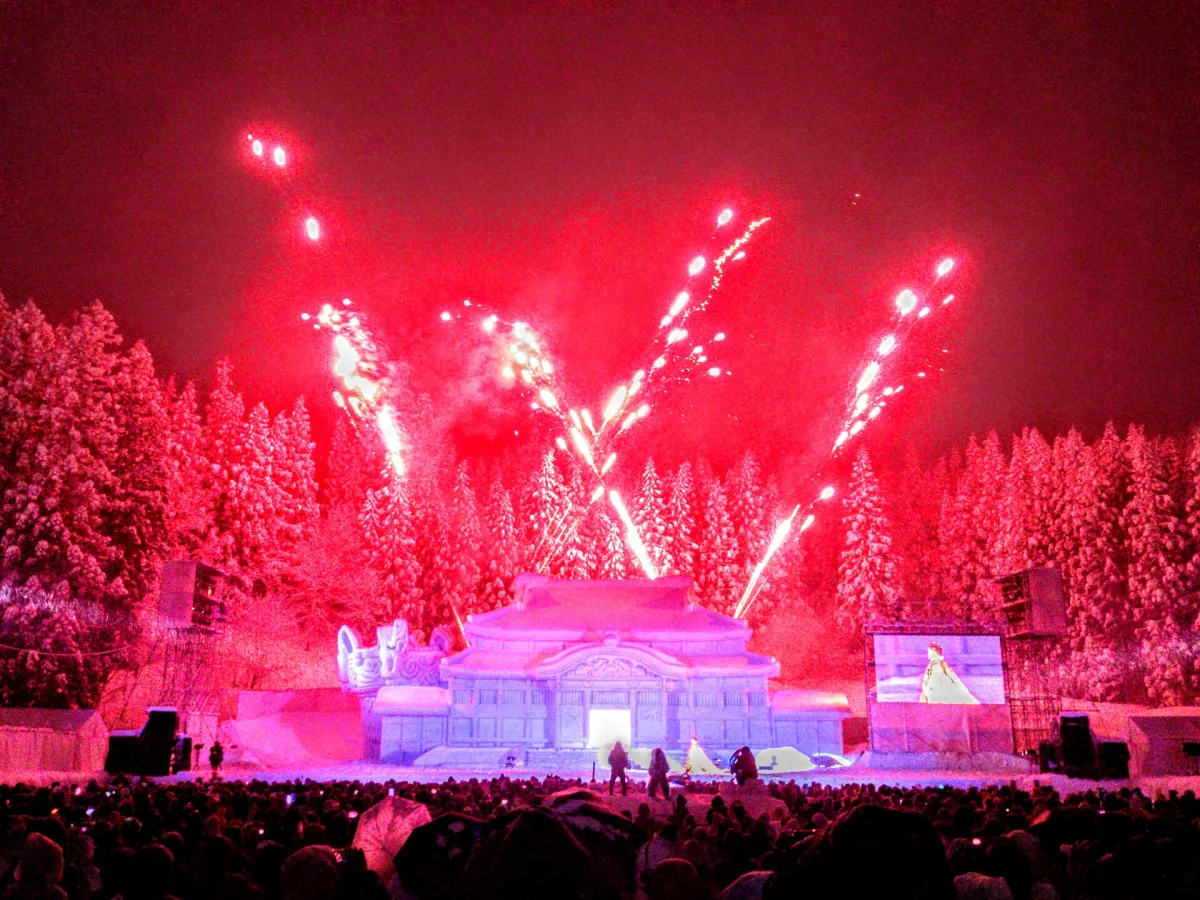
The festival was once famous for its Snow Carnival, a huge stage built of snow where well-known singers performed, and in 1982 the snow stage built the previous year was recognised by the Guinness Book of Records as "the world's largest structure made of snow". But in 2019 a snow sculpture collapsed on a stage under construction, and after reviewing this along with cost-effectiveness and other points, the Snow Carnival came to an end. Since 2020 the festival has returned to its roots as a handmade festival starring local residents.
Highlight 1: snow art made by residents
At the heart of the festival are snow sculptures made by hand by neighbourhood associations, local groups, schools and others. The official website describes them as the origin of the festival. They range in size from about as big as a house to about as big as a dump truck and take a week to ten days to make.
The sculptures are displayed as the Snow Art Exhibition in three categories, art, special and schoolchildren, and prizes in the art category are decided by judging. At the 77th festival in 2026, 17 works were entered in the art category and judged on the evening of the opening Friday. The schoolchildren category shows works by elementary and junior high school pupils. As the sculptures are dotted around the city, the basic way to enjoy them is to tour them with the leaflet map in hand.
Highlight 2: festival plazas run by locals
The "omatsuri hiroba" (festival plazas) are venues run by each community, from the town centre to mountain villages. They welcome visitors with snow games, stalls of local food and more. In 2026, 14 plazas opened, some of them on Saturday only.
In recent years a main area has been set up within walking distance of Tokamachi Station, with food stalls, stage shows and activities on the snow. In 2026 the grounds of the city's Nishi Elementary School became the "Snow Rich Plaza", and at night "Niji Yuki Hanabi" (rainbow snow fireworks) were set off over the snow. The area around the city museum became "TOPPAKU Park", with sledge pulling for children and a corner where you could dress up in traditional snow-country clothing for photos in a hon'yaradō, a hut made of snow.
Snow country conditions and getting around
Tokamachi is one of the snowiest places in Japan. According to statistics compiled by the city, the snow depth at the snowiest time of year averages as much as 234 centimetres. Snow may keep falling during the festival; in 2026 a notice went out that the size of the temporary car parks was changing because of continuous snowfall. Wear shoes you can walk in on snowy paths and warm clothes that shed snow.
From Tokyo, take the Joetsu Shinkansen to Echigo-Yuzawa Station and change to the Hokuhoku Line for Tokamachi Station, about two hours in all. Special trains from the Tokyo area and Nagano sometimes run during the festival; in 2026 there was the limited express "Hokuhoku Tokamachi Yukimatsuri" from Shinjuku.
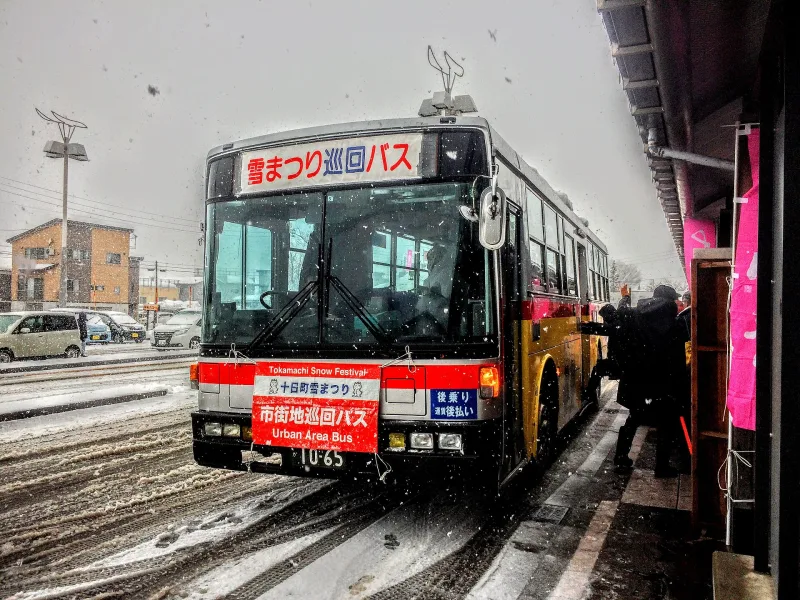
The sculptures and plazas are spread widely across the city, too far to see on foot alone. At weekends a free shuttle bus runs around the city, along with a paid tour bus that visits plazas and sculptures in different areas. English leaflets are also handed out at the venues.
Tips
- In 2026 and 2027 the art category is judged on the evening of the opening Friday (in 2026, Friday evening was for viewing the sculptures only, with no food stalls). It suits anyone who wants a quiet look at freshly finished sculptures.
- The snow sculptures are scattered all over the city. Get around using the map in the leaflet handed out at the venues together with the tour buses.
- On the map in the festival-day leaflet, the plazas are marked with circled numbers and the snow sculptures with numbers in squares.
- If you drive, temporary car parks are provided during the festival, but the number of spaces can shrink depending on the snow. Travelling by train is the safer choice.
- For foreign-language information, an English version of the leaflet is handed out at the venues.
Sources
- 十日町雪まつり公式サイト (opens in a new tab)
- 十日町雪まつり公式サイト「十日町雪まつりとは」 (opens in a new tab)
- 十日町雪まつり公式サイト「十日町雪まつりの歴史」 (opens in a new tab)
- Tokamachi Snow Festival official site "Tokamachi Snow Festival / The 77th Tokamachi Snow Festival" (opens in a new tab)
- 十日町雪まつり公式サイト「第78回十日町雪まつりの開催について」 (opens in a new tab)
- 十日町雪まつり公式サイト「第77回十日町雪まつり実施企画について」 (opens in a new tab)
- 十日町雪まつり公式サイト「【第77回】おまつりひろば情報」 (opens in a new tab)
- 十日町雪まつり公式サイト「【第77回】臨時駐車場・シャトルバス情報」 (opens in a new tab)
- 十日町雪まつり公式サイト「【第77回】十日町雪まつりの臨時列車が運行します」 (opens in a new tab)
- 十日町雪まつり公式サイト「【第77回】十日町雪まつりレポート(1・2日目)」 (opens in a new tab)
- 十日町雪まつり公式サイト「【第77回】十日町雪まつりレポート(3日目)」 (opens in a new tab)
- 十日町雪まつり公式サイト「【第76回】十日町雪まつりレポート(1日目)」 (opens in a new tab)
- 十日町雪まつり公式サイト「【第76回】十日町雪まつりレポート(2日目)」 (opens in a new tab)
- 十日町雪まつり公式サイト「【第75回】十日町雪まつりレポート」 (opens in a new tab)
- 十日町雪まつり公式サイト「【第74回】十日町雪まつりレポート」 (opens in a new tab)
- 十日町市「雪国Q&A 雪まつり・雪あそび」 (opens in a new tab)
- 十日町市「雪国のくらし 統計」 (opens in a new tab)
- Wikipedia「十日町雪まつり」 (opens in a new tab)