Japan is Nippon
Wakakusa Yamayaki (Mount Wakakusa Burning)
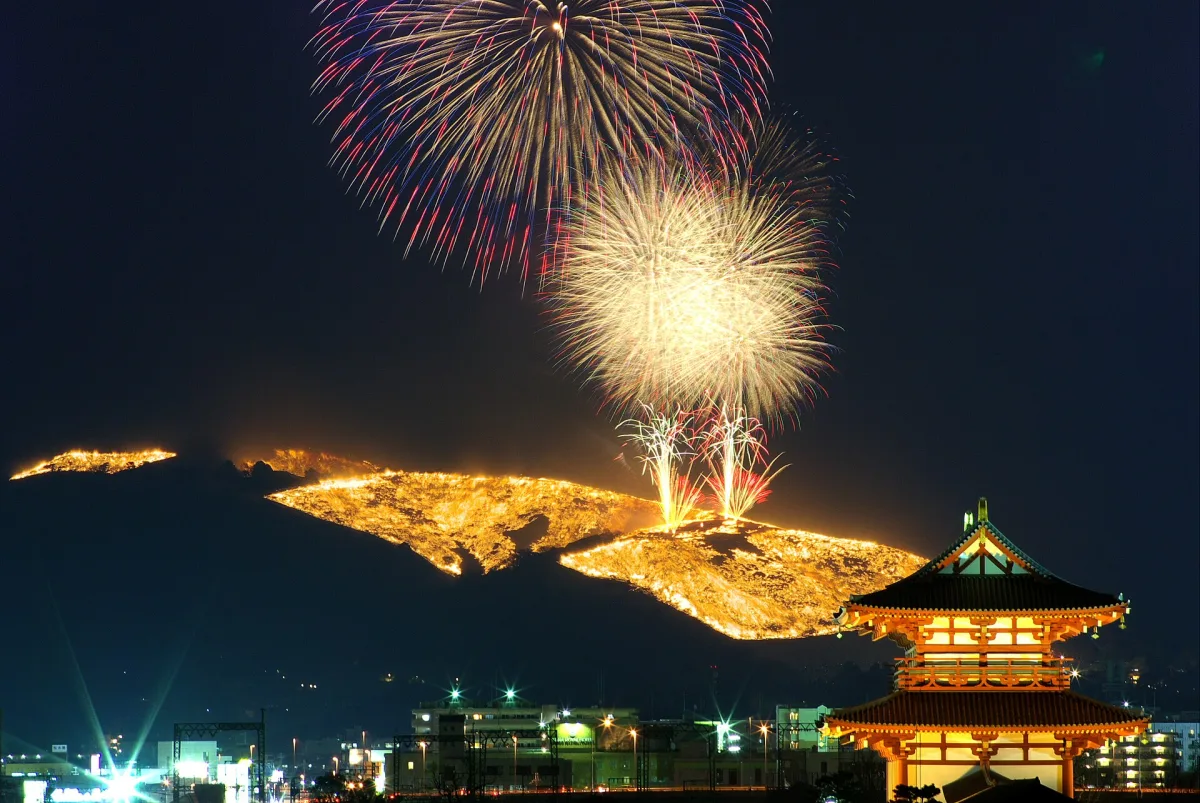
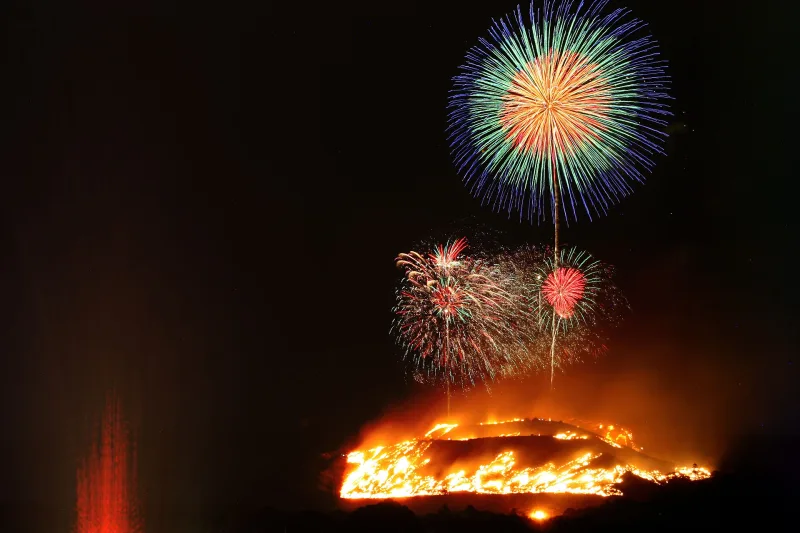
The grassy slopes of Nara's Mount Wakakusa set ablaze on a winter night: a fire rite said to calm an ancient tomb's spirits, heralding early spring.
Nara
- NaraMount Wakakusa in Nara Park, Nara city; the sacred fire is carried from Tobihino in the grounds of Kasuga Taisha to Nogami Shrine at the foot of the hill
Recent years
| Year | Dates | Visitors | Notes |
|---|---|---|---|
| 2027 | 23 January (planned) | — | Date based on the prefecture's rule that the event is held on the fourth Saturday of January each year. |
| 2026 | 24 January | — | Paid viewing areas were set up for the first time, including inside the gate at the foot of the hill, to prevent crowd crush accidents. After about 600 fireworks, the hill was lit at around 6.30pm. |
| 2025 | 25 January | about 190,000 (estimated) | Reported as a record number of spectators, with about 10,000 people gathered inside the gate at the foot of the hill. This led to some areas becoming paid from the following year. |
| 2024 | 27 January | — | Good weather meant that, unlike the year before, the whole hill burned well. |
| 2023 | 28 January | about 170,000 | COVID-19 viewing restrictions were lifted and the event was held normally for the first time in three years. But because of snow just beforehand, the fire did not spread, and only about a tenth of the hill burned. |
When and where is it held?
Wakakusa Yamayaki ("the burning of Mount Wakakusa") takes place every year on the fourth Saturday of January on Mount Wakakusa in Nara Park, Nara city. It is organised by the Wakakusa Yamayaki Executive Committee, made up of Nara Prefecture and others. After fireworks in the evening, the hill's grassland is set alight all at once and the flames race up the slope.
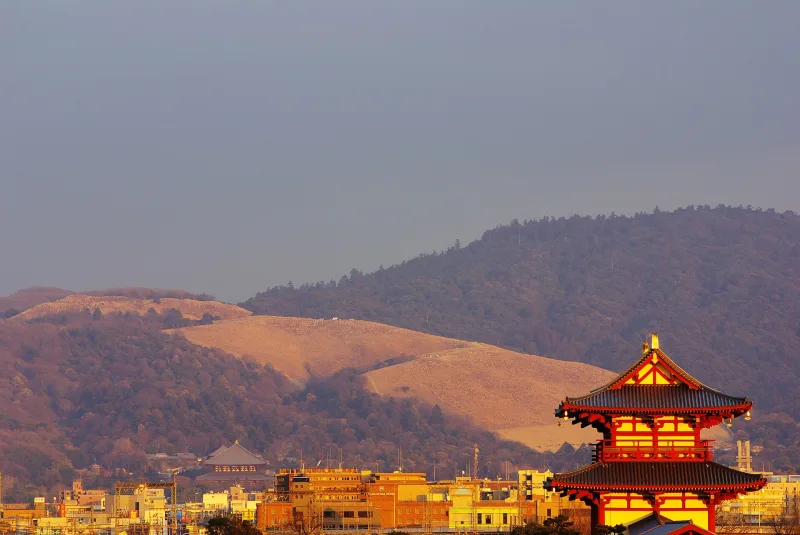
Mount Wakakusa is 342 metres high and covers 33 hectares. It is shaped like three gentle, rounded grassy hills stacked together, and deer are often seen there on ordinary days. Because it is surrounded by World Heritage sites such as Todaiji, Kasuga Taisha and the Kasugayama Primeval Forest, the burning is carried out with great care to stop the fire spreading.
A hill burning that began with a ghost story
On the summit of Mount Wakakusa is the Uguisuzuka Kofun, a large zenpo-koen-fun (an ancient keyhole-shaped tomb). According to Nara Prefecture, there were once superstitions such as "ghosts come out of this tomb, but burning the hill will stop them" and "if the hill isn't burned before the new year, something bad will happen", and people passing over the hill are said to have started setting it alight on their own.
The fires often came close to the grounds of Todaiji, and in 1738 the Nara magistrate's office put up signs banning arson. Even so, the fires did not stop, and towards the end of the Edo period the hill came to be burned in the presence of Todaiji, Kofukuji and the magistrate's office. From this history, the prefecture explains that the burning was originally a rite to calm the spirits resting in the tomb, and a memorial for them too.
It took its present form in 1900 (Meiji 33), when what had been a daytime event became a night-time one. The date moved from 11 February to 15 January (Coming of Age Day) and then to the Sunday before Coming of Age Day, and since 2009 it has been the fourth Saturday of January. Today it is described as an event in which the gods and Buddhas of Kasuga Taisha, Kofukuji and Todaiji together console the spirits of those who came before and pray for fire safety in Nara and for world peace.
How the day unfolds: sacred fire, fireworks, then ignition
In the afternoon, the Kasuga no Otondo bonfire is held at Tobihino in the grounds of Kasuga Taisha, burning old talismans and shimenawa (sacred straw rope) decorations offered at New Year. In the evening, a ceremony receives the fire of this bonfire as goshinka (sacred fire), and a "sacred flame procession" of about 40 people, led by yamabushi (mountain ascetics) blowing conch shells and including people from Kasuga Taisha, Kofukuji and Todaiji as well as people dressed as officials of the Nara magistrate's office, carries the fire to Nogami Shrine at the foot of Mount Wakakusa.
After a ceremony at Nogami Shrine to pray for the burning to go safely, the big fireworks display begins at around 6.15pm. It includes large shakudama shells, rare in the prefecture, and in recent years about 600 fireworks have been set off.
When the fireworks end, at around 6.30pm, about 300 members of the Nara City Volunteer Fire Corps light taimatsu (torches) from a great bonfire at the foot of the hill, carry them to the front of the slope and, at the signal of conch shells and bugles, set fire all at once to grassland with a perimeter of 3,800 metres. Depending on the weather, the fire spreads in one rush and burns out in about 30 minutes to an hour.
The work behind the flames
To keep the fire from spreading beyond the hill, the silver grass around the burning area is cut beforehand to make a firebreak of a set width. The torches used for the sacred flame procession and the great bonfire are all made by hand by staff of the Nara Park office. They are made from "jin", the resin-rich root part of pine trees, taken from fallen trees and the like in Nara Park and left to dry for years before use. Around 1,000 are said to be prepared every year from autumn to winter.
Crowds, weather and things to watch out for
Spectator numbers rose after the pandemic, and in 2025 about 190,000 people were reported to have come, by one estimate. About 10,000 crowded inside the gate at the foot of the hill, right below the slope, so to prevent crowd crush accidents, from 2026 the area inside that gate and the roof of the Nara Park Bus Terminal became paid viewing areas with advance tickets. Ticket income goes towards security and other safety measures.
There is no dedicated car park, and on the day traffic is restricted around Nara Park from about 3pm to about 8pm. The New Wakakusayama Driveway and the footpaths up Mount Wakakusa are also closed from midday. The event may be cancelled in stormy weather, and if it is cancelled it is not postponed. It goes ahead in light rain, but if the grass is damp it may not catch fire.
Tips
- Come by train, bus and on foot, not by car. Roads around Nara Park are fully closed to traffic in the evening, and for some hours even tour buses and taxis cannot get through.
- To watch from right below the slope, you need an advance ticket for a paid viewing area (for 2026, tickets went on sale in mid-November of the previous year). Because the whole hill burns, you can also see the flames from places well away from its foot.
- Seeing the Kasuga no Otondo bonfire at Tobihino and the sacred flame procession during the afternoon helps you follow how the whole event unfolds.
- You will be waiting outdoors for a long time on a January night, so bring plenty of warm clothing.
- After rain or snow the grass may not burn as well. Check Nara Prefecture's official information on the day to see whether the event is going ahead.
Sources
- 奈良県「若草山焼き行事」 (opens in a new tab)
- 奈良県「若草山焼きの起源」 (opens in a new tab)
- 奈良県「山焼き・花火」 (opens in a new tab)
- 奈良県「聖火行列・祭典」 (opens in a new tab)
- 奈良県「若草山焼き行事のよくある質問」 (opens in a new tab)
- 奈良県「若草山焼き行事の舞台裏」 (opens in a new tab)
- 奈良県 奈良公園クイックガイド「若草山」 (opens in a new tab)
- 産経ニュース「早春を告げる奈良の『若草山焼き』山麓ゲート内など有料化」(2025年) (opens in a new tab)
- 奈良新聞「2026年1月の奈良県若草山焼き、有料観覧エリアのチケット販売」(2025年) (opens in a new tab)
- 奈良新聞「凍てつく古都、赤々夜空 奈良の伝統行事『若草山焼き』 花火も共演」(2026年) (opens in a new tab)
- 共同通信(福島民友)「奈良で若草山焼き、夜空彩る炎」(2026年) (opens in a new tab)
- デイリースポーツ「2024年はよく燃えた、奈良の伝統行事『若草山焼き』に大歓声」(2024年) (opens in a new tab)
- 奈良新聞「早春告げる炎 世界の平安祈り 奈良で若草山焼き」(2024年) (opens in a new tab)
- 日本経済新聞(共同)「若草山焼き、3年ぶり通常開催 雪の影響で燃え広がらず」(2023年) (opens in a new tab)