Japan is Nippon
Yokote Kamakura Festival
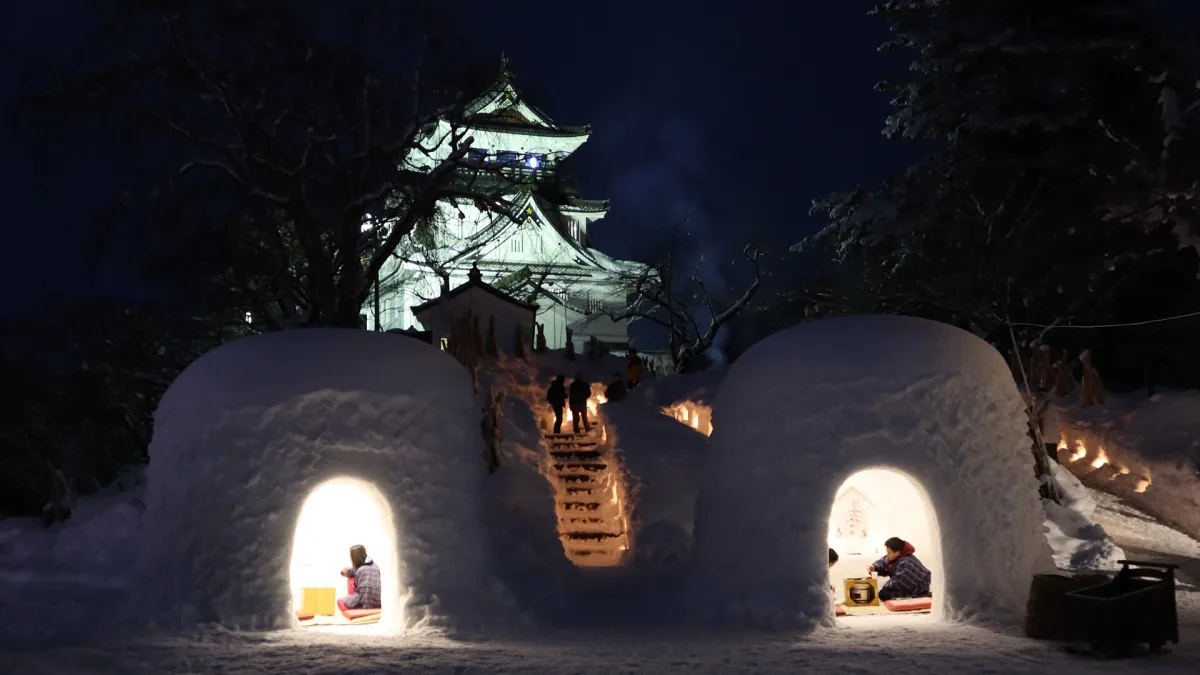
Children invite passers-by into little snow rooms honouring the water god: a winter-night tradition in Yokote, Akita, said to be about 450 years old.
Akita
- AkitaVarious spots in Yokote city, such as in front of the main city hall, Yokote Park and Futabacho (mini kamakura at the Janosaki riverbank)
Recent years
| Year | Dates | Visitors | Notes |
|---|---|---|---|
| 2027 | 12 and 13 February (planned) | — | Announced by Yokote city. The second year of the trial "second Friday and Saturday of February" schedule introduced in 2026. |
| 2026 | 13 and 14 February | — | The long-standing fixed dates of 15 and 16 February were dropped, and the festival was held on a Friday and Saturday for the first time (a trial change until 2029). |
| 2025 | 15 and 16 February | 240,000 (over two days) | About 60 kamakura in all were built, in front of the main city hall, in Yokote Park and elsewhere. Visitor numbers were reported to be up 70,000 on the previous year. |
| 2024 | 15 and 16 February | — | A mild winter left too little snow, so snow was brought in from outside the city, including from mountain areas of Higashinaruse village, to build about 50 kamakura. It rained on the opening day too, and in an unusual turn the kamakura were covered with blue tarpaulins. |
| 2023 | 15 and 16 February | — | After events for tourists were called off in 2021 and 2022 because of COVID-19, tourists were welcomed for the first time in three years. There were about 40 kamakura, around half the usual number, centred on two venues, in front of the main city hall and Yokote Park, and children did not serve amazake or rice cakes. |
When and where is it held?
The Yokote Kamakura is a traditional Koshogatsu event held on mid-February nights every year in Yokote city, in southern Akita Prefecture. Koshogatsu ("Little New Year") is the time around the 15th day of the first month of the old lunar calendar, traditionally marked by events that round off the New Year season. The venues are spread around the city, including in front of Yokote's main city hall, Yokote Park and Futabacho, and about 60 kamakura (snow huts) are built across the city for the festival.
For many years it was held on fixed dates, 15 and 16 February. To ease the load on the residents who keep it running and to draw more visitors, from 2026 to 2029 it has moved on a trial basis to two days, "the second Friday and Saturday of February". According to Yokote city's official website, the next festival, in 2027, is on Friday 12 and Saturday 13 February.
Together with the bonden (decorated ritual poles) and snow sculpture displays held at the same time of year, the kamakura make up what is called the Yokote Snow Festival. As the bonden is a Shinto rite, its dates are fixed: in 2026 the bonden contest was held on 16 February and the offering at Asahiokayama Shrine on the 17th.
What goes on inside a kamakura?
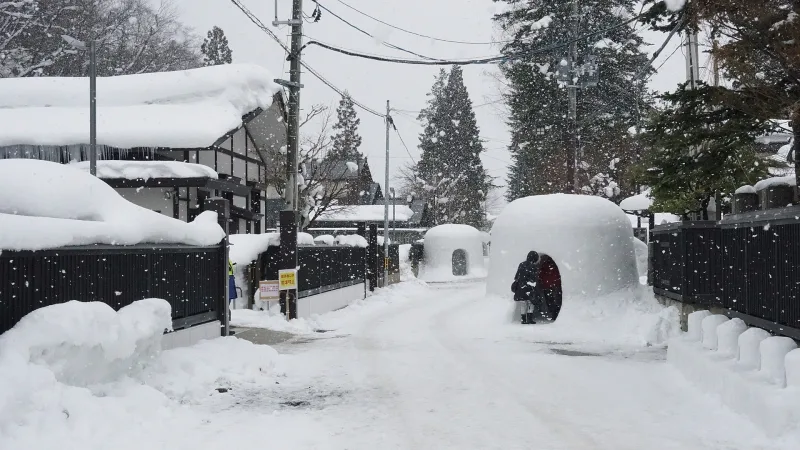
A kamakura is a room made of packed snow, hollowed out and big enough for people to sit in. At the back, facing the entrance, an altar is made to enshrine Suijin-sama, the water god. It began as a custom of making an osaisen (an offering of coins to a god) to the water god and praying for family safety, thriving business and a good harvest.
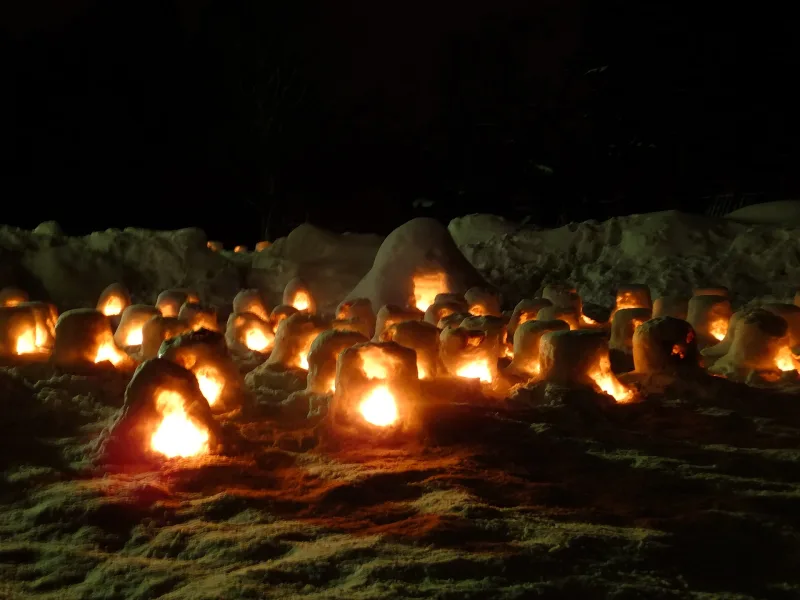
Local children sit inside the kamakura and call out to you, "haitte tanse" (please come into the kamakura) and "ogande tanse" (please pray to the water god), and offer you amaeko (amazake, a sweet rice drink) and rice cakes. After dark the kamakura are lit from inside, wrapping the snowy town in a magical atmosphere.
According to Yokote city, the kamakura made under the tourism association's guidance are built by piling up snow within a circle about 3.5 metres across, treading it firm, to a height of around 3 metres, then digging out the inside while leaving walls about 50 centimetres thick. Once the event is over, they are knocked down with heavy machinery within a few days for safety.
Two roots: a samurai town and a merchant town
The Yokote Kamakura is said to have about 450 years of history. In the Edo period, in Uchimachi, the district where samurai lived, people built square snow walls on the night of the 14th day of the first lunar month, burned New Year pine decorations and shimenawa (sacred straw ropes) inside them, and prayed to ward off misfortune and for their children to grow up well. Meanwhile in Tomachi, the merchants' district, people dug snow holes beside their wells on the night of the 15th day of the first lunar month and prayed to the water god for good water.
Tradition has it that these customs blended with children's games of digging holes in the piled-up snow, becoming today's kamakura that enshrine the water god. There are several theories about where the name "kamakura" comes from, such as its resemblance to a kamado (cooking stove), or kamikura, "the seat of a god", and no one knows which is correct.
In 1936 (Showa 11), the German architect Bruno Taut saw kamakura in Yokote and praised their beauty in one of his books. The present rounded-roof shape is based on a "model kamakura" made in 1959 (Showa 34). As car traffic grew, it became harder to build kamakura on the roads, and from around 1971 (Showa 46) a movement to build small "mini kamakura" all over town also spread.
More to see beyond the kamakura
At the Janosaki riverbank along the Yokote River, rows of lit mini kamakura create a magical scene. At Kido Gorobei Village, an open-air collection of old farmhouses in the city's Omonogawa district, photo sessions are held where you can shoot kamakura with the old houses behind.
Even if you can't make it at festival time, at Kamakura-kan, in Chuocho like the main city hall, you can see a real kamakura made from Yokote snow all year round, in a room kept at about minus 10°C. However, the exhibition room is closed for about a week in summer and in February while the kamakura is rebuilt, so check the tourism association's information before you go.
Crowds and tips for visiting
According to NHK, 240,000 people visited over the two days in 2025. The main venues are in front of the main city hall and Yokote Park, and the kamakura are lit after sunset.
A kamakura is a place where children welcome you, and also a place of prayer to the water god. When you go inside, put your hands together before the water god on the altar. You will be walking on snow for a long time, so non-slip shoes and warm things such as gloves and a hat are a good idea.
Tips
- The next festival, in 2027, is on Friday 12 and Saturday 13 February. From 2026 to 2029 it is handy to remember "the second Friday and Saturday of February".
- The kamakura are lit after dark. Walk around town by day, then tour the venues again at night to enjoy the change of atmosphere.
- If children call you over from inside a kamakura, put your hands together before the water god and leave an offering of coins. The tradition began as a time to make an offering and a wish.
- If you want photos, look out for the rows of mini kamakura at the Janosaki riverbank, and the photo sessions at Kido Gorobei Village, where you can shoot with old farmhouses behind.
- If you visit outside festival time, go to Kamakura-kan, where you can see a kamakura all year round. It also has a Yokote City Tourism Association shop selling local specialities such as Yokote yakisoba.
Sources
- 横手市観光協会「かまくら」 (opens in a new tab)
- 横手市観光協会「令和7年度(2026年)「横手の雪まつり」開催日程について」 (opens in a new tab)
- 横手市観光協会「かまくら館」 (opens in a new tab)
- 横手市公式サイト「(冬)横手のかまくら」 (opens in a new tab)
- NHK秋田「「横手のかまくら」来年から日程変更へ より多くの観光客を」(2025年7月17日) (opens in a new tab)
- 秋田魁新報「小正月行事「かまくら」 26年から金、土曜開催 横手市観光協会が発表」 (opens in a new tab)
- 秋田魁新報「かまくらに明かり、雪国の情緒たっぷり 横手市で16日まで」(2025年) (opens in a new tab)
- 秋田魁新報「雪不足、雨の中で「かまくら」開幕 ブルーシートに覆われて…」(2024年) (opens in a new tab)
- 秋田魁新報「雪が足りない…横手の「かまくら」ピンチ 各地から調達も路面はむき出し」(2024年) (opens in a new tab)
- 秋田魁新報「お疲れさま、横手のかまくら解体 職人「ようやく肩の荷下りた」」(2024年) (opens in a new tab)
- 秋田魁新報「幻想的!「かまくら」に明かりともる 3年ぶりに観光客受け入れ」(2023年) (opens in a new tab)
- 秋田魁新報「横手の「かまくら」 3年ぶり観光客迎え開催へ」(2022年12月) (opens in a new tab)
- 秋田魁新報「観光かまくら2年連続中止 横手市、オミクロン株急拡大受け」(2022年) (opens in a new tab)
- Wikipedia「横手の雪まつり」(補助資料) (opens in a new tab)