Japan is Nippon
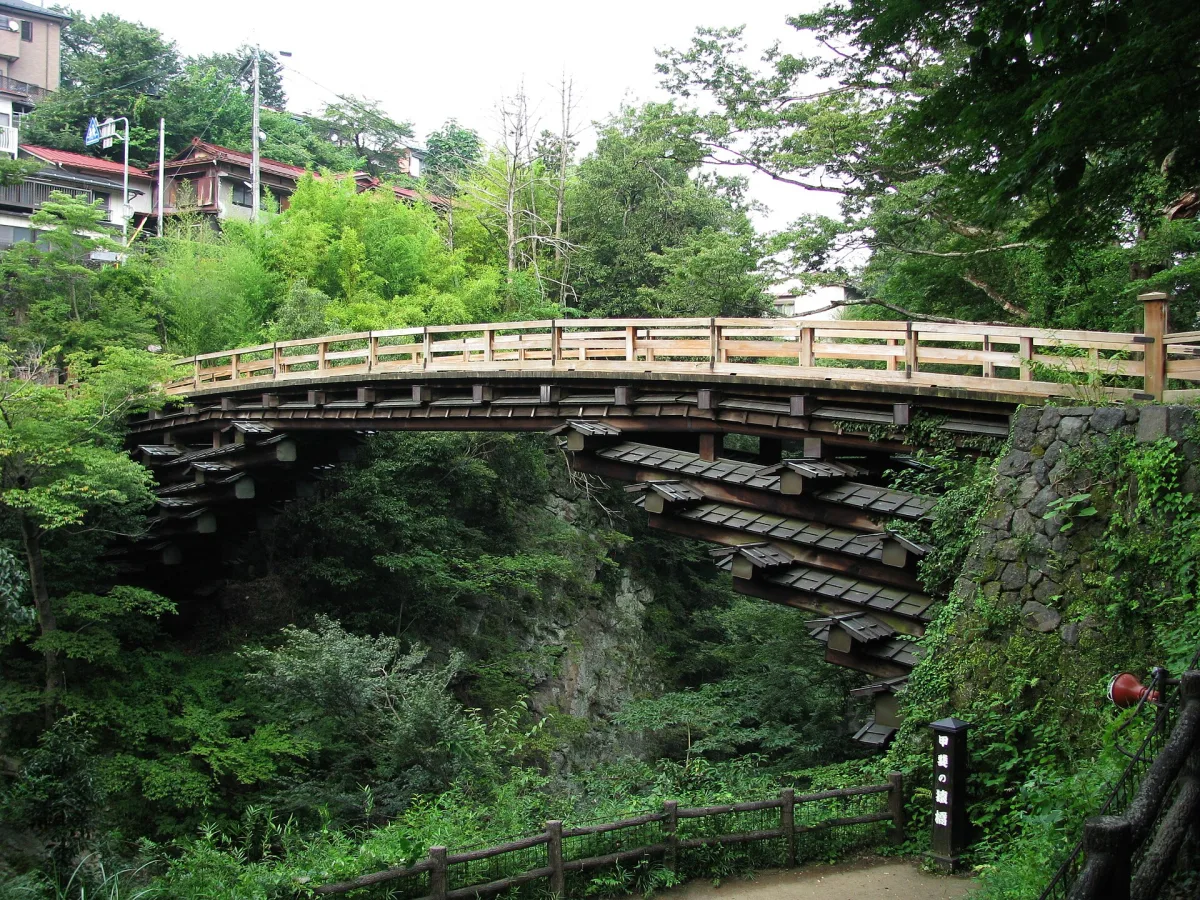
Saruhashi Bridge
猿橋
One of Japan's "three strange bridges", spanning a deep gorge with no piers, on beams jutting out in four tiers from each bank. A Koshu Kaido landmark Hiroshige painted.
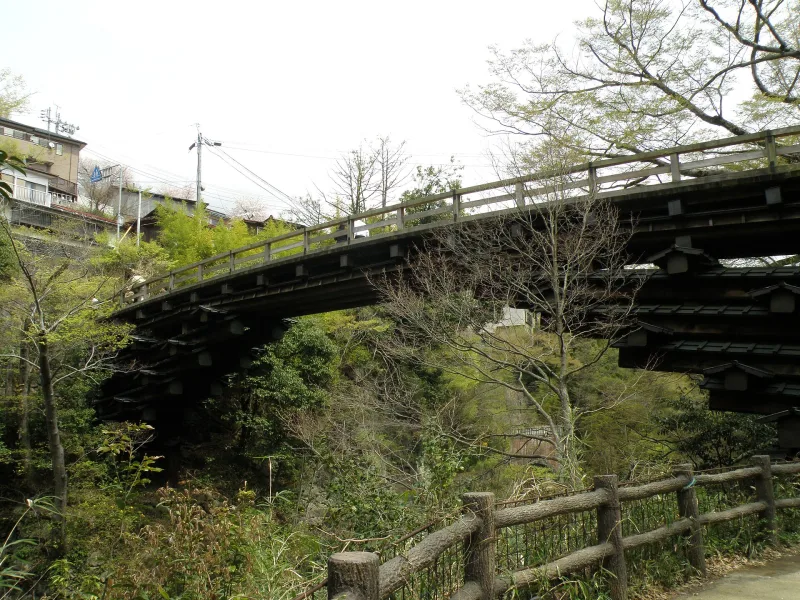
A bridge over the gorge the monkeys crossed hand in hand
Saruhashi Bridge is a wooden bridge over the gorge of the Katsura River in Otsuki, Yamanashi Prefecture. It is 30.9m long and 3.3m wide, and stands 31m above the water. Together with the Kintaikyo Bridge in Iwakuni (Yamaguchi Prefecture) and the Kakehashi in Kiso (Nagano Prefecture), it is counted as one of the "three strange bridges of Japan" (three bridges known for their unusual construction), and it was designated a national Place of Scenic Beauty in 1932.
There is a legend behind the name, which means "monkey bridge". According to Otsuki City, around the year 600 a man named Shirako, who had come from Baekje (an ancient kingdom on the Korean Peninsula), watched monkeys linking their bodies together to cross the gorge, and came up with the idea for this bridge.
How a hanebashi works, with no piers
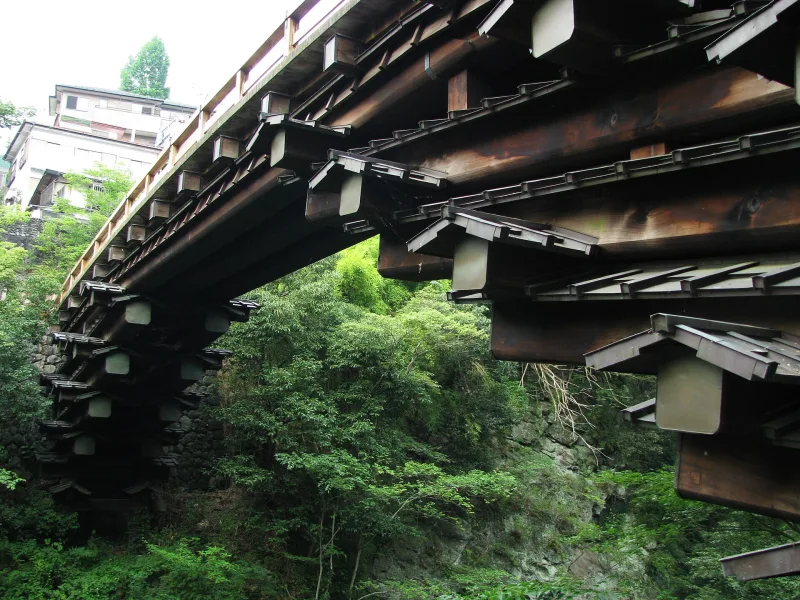
The gorge is so deep that piers (the columns that hold up a bridge) could not be set in the river, so Saruhashi was built as a hanebashi, a cantilever bridge. Wooden beams called hanegi are driven into the cliffs on both banks and stacked in four tiers, each jutting out a little further than the one below, and the bridge deck rests on top of them.
The present bridge was rebuilt in 1984 based on records from 1851. There are modern bridges upstream and downstream, and downstream there is also the Yatsusawa Power Station No. 1 Aqueduct Bridge, a national Important Cultural Property, so you can compare bridges from different eras.
A Koshu Kaido landmark painted by Hiroshige
Saruhashi lies on the Koshu Kaido, one of the major highways of the Edo period, and it has long been a famous sight known to travellers. The ukiyo-e artist Utagawa Hiroshige also visited and painted it in "The Monkey Bridge in Kai Province" (Koyo Saruhashi no Zu).
In autumn the maples, ginkgoes and zelkovas change colour, and Yamanashi Prefecture's tourism website gives mid-November to early December as the best time. In winter, once the leaves have fallen, you can see traces of lava that flowed here from an ancient eruption of Mount Fuji on the rock faces of the gorge.
Getting there
It is a 15-20 minute walk from Saruhashi Station on the JR Chuo Line. By car it is about 20 minutes from Otsuki IC (interchange) on the Chuo Expressway, and there is a car park nearby.
Tips
- The highlight of Saruhashi is the hanegi, the beams stacked in four tiers jutting out from both banks. Don't just walk across the bridge: look at it from the side as well to see how it is built.
- Saruhashi Park, right nearby, has an observation deck and a hydrangea path, and the hydrangeas are at their best in late June.
- The small shrine at the foot of the bridge, Sannogu, is said in local lore to be dedicated to the monkeys that inspired the bridge.
Sources
- 日本三奇橋 猿橋|大月市 (opens in a new tab)
- 猿橋|富士の国やまなし観光ネット (opens in a new tab)
- 猿橋 - Wikipedia (opens in a new tab)
Updated 30 September 2026. Opening hours and prices change, so check the official site before you go.