Dazaifu Tenmangu
太宰府天満宮
Head shrine of all Tenmangu, built over the grave of Sugawara no Michizane. Worship at the main hall resumed in September 2026 after 3.5 years of repairs.
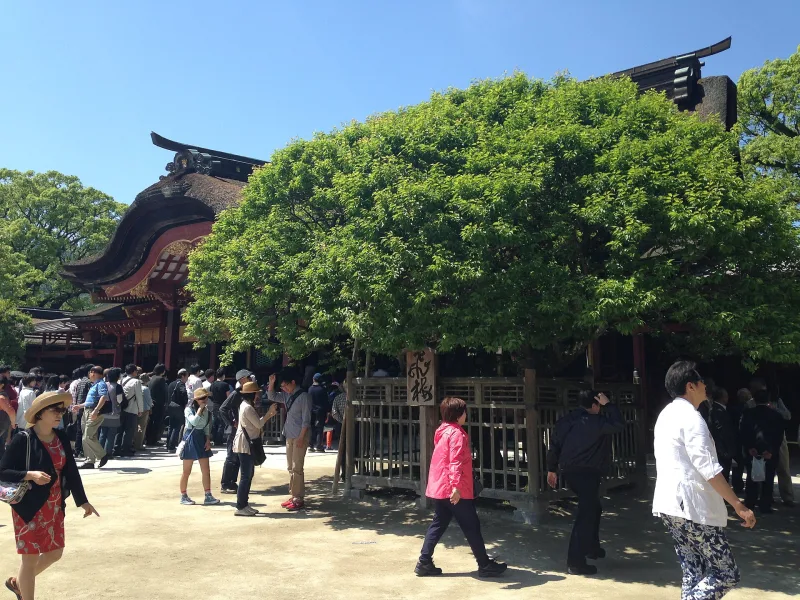
Where the god of learning rests
Dazaifu Tenmangu is a shrine in Dazaifu, Fukuoka Prefecture. It enshrines Sugawara no Michizane, a scholar and statesman of the Heian period. In 901 Michizane was caught up in a political struggle and demoted from Kyoto to the Dazaifu, the government office that ruled Kyushu, and he died here in 903.
According to legend, the ox pulling the cart that carried his body sat down on the way and refused to move. People took this as Michizane's wish and buried him on that spot. In 919, on the orders of the imperial court, a shrine was built there, and that was the beginning of Dazaifu Tenmangu.
Michizane later came to be worshipped as Tenjin-sama and revered as a god of learning and the performing arts. Dazaifu Tenmangu is the head shrine of the Tenmangu shrines, said to number about 10,000 across Japan.
The main hall and the Tobiume plum tree
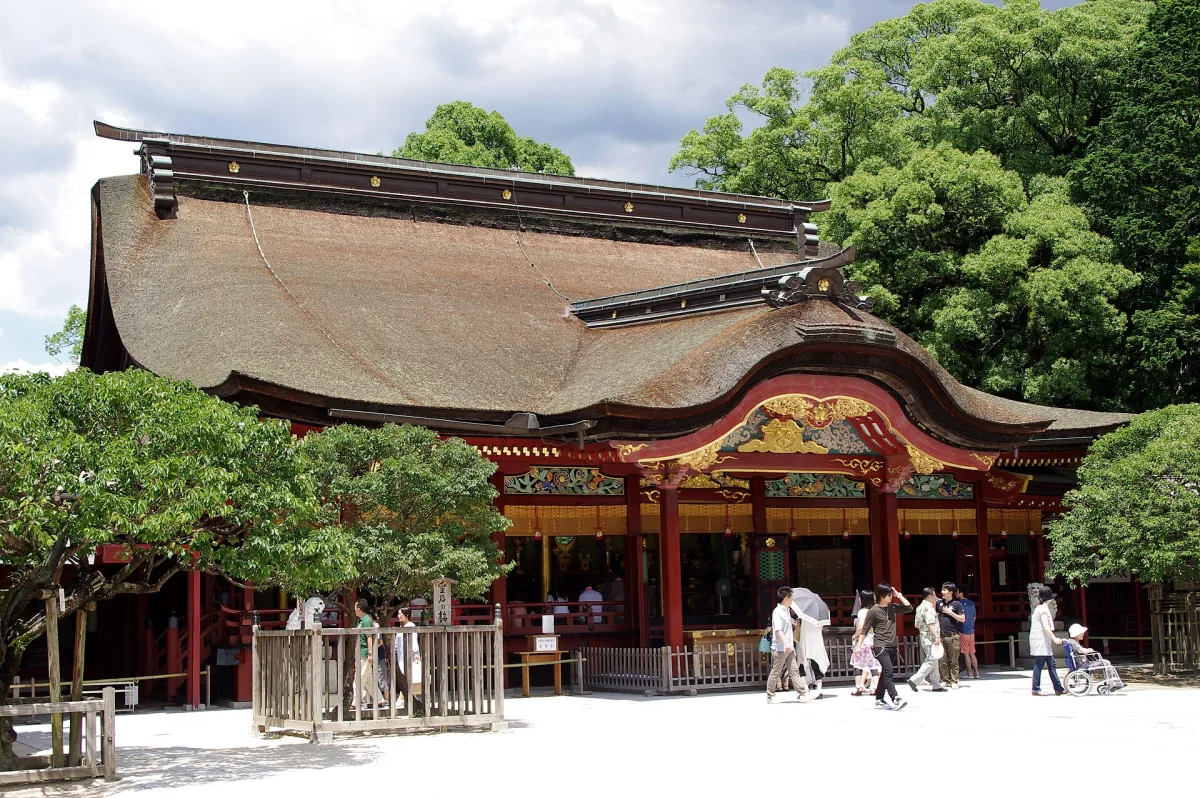
The present main hall was built in 1591 with a donation from the warlord Kobayakawa Takakage, and it is an Important Cultural Property of Japan that preserves the lavish style of the Momoyama period. It underwent major repairs from spring 2023, and on 19 September 2026 worship in front of the main hall resumed for the first time in about three and a half years.
To the right of the main hall as you face it stands a plum tree called Tobiume, the "flying plum". Legend says it missed Michizane so much that it flew from Kyoto to Dazaifu in a single night.
Highlights in the grounds
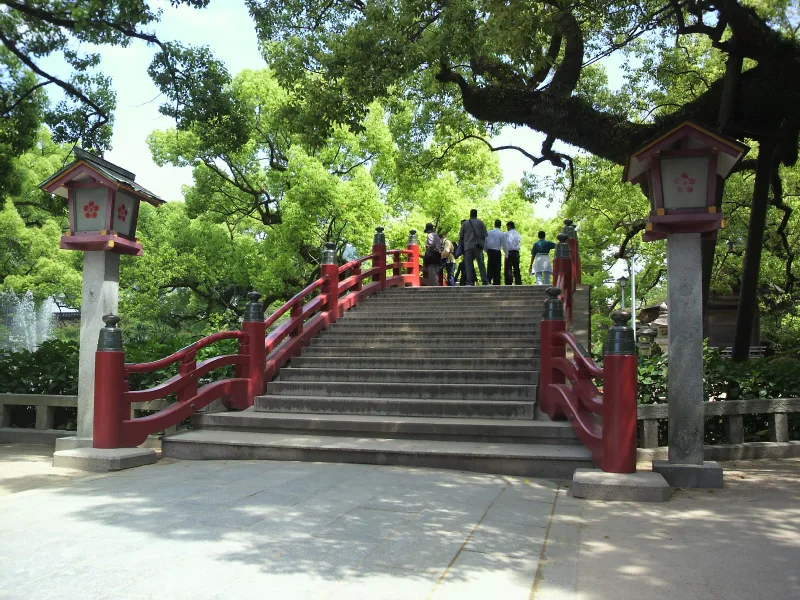
On the way to the main hall you pass Shinji-ike, a pond shaped like the character for "heart" (心), crossed by three taikobashi (arched bridges that curve up in a half-circle). The bridges stand for the past, present and future, and crossing them is said to purify your body and mind before you stand before the god.
The grounds have 11 statues of goshingyu, the sacred ox regarded as the god's messenger, because Michizane is believed to have a deep bond with oxen.
Other sights include a great camphor tree about 1,500 years old, designated a national Natural Monument; the treasure hall, which holds items connected with Michizane and the shrine; and Kaso Nakashima Shrine, an unusual shrine to the god of sweets. The romon (two-storey gate) in front of the main hall was rebuilt in 1914.
Getting there
From Tenjin in Fukuoka City, take the Nishitetsu train, change to the Dazaifu Line at Futsukaichi Station and ride to Dazaifu Station, about 35 minutes in all. The shrine is about 5 minutes' walk from the station.
The Tabito direct bus runs from Hakata Bus Terminal to Dazaifu Station in about 45 minutes, and Tabito also runs from the international terminal of Fukuoka Airport in about 25 minutes.
Tips
- There are 11 ox statues, so see how many you can find as you walk around the grounds.
- If you come by car, it is about 7 minutes' walk from the large car park (Dazaifu Parking Center) to the approach. By train, it is about 5 minutes from Dazaifu Station.
- Where you apply for a kigan (a ritual in which a priest prays on your behalf) can change depending on the time of year. If you want one, check the notices on the official website.
Sources
Updated 28 September 2026. Opening hours and prices change, so check the official site before you go.