Yamaguchi
At the western tip of Honshu, Yamaguchi combines two contrasting coasts, limestone grasslands and towns shaped by samurai history.
Map outlines: Natural Earth
-
1
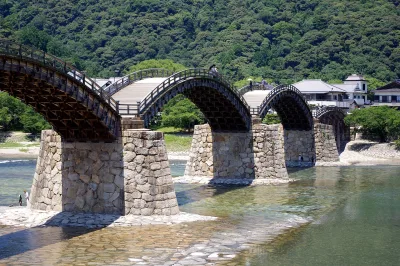 Kintaikyo Bridge
Iwakuni's wooden bridge of five arches over the Nishiki River. Rebuilt again and again since the Edo period, it is still yours to walk across.
Kintaikyo Bridge
Iwakuni's wooden bridge of five arches over the Nishiki River. Rebuilt again and again since the Edo period, it is still yours to walk across.
-
2
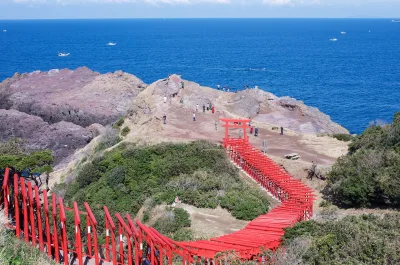 Motonosumi Shrine
A Nagato shrine where 123 red torii gates run from a clifftop towards the Sea of Japan. Blue sea, green and vermilion made it famous worldwide.
Motonosumi Shrine
A Nagato shrine where 123 red torii gates run from a clifftop towards the Sea of Japan. Blue sea, green and vermilion made it famous worldwide.
-
3
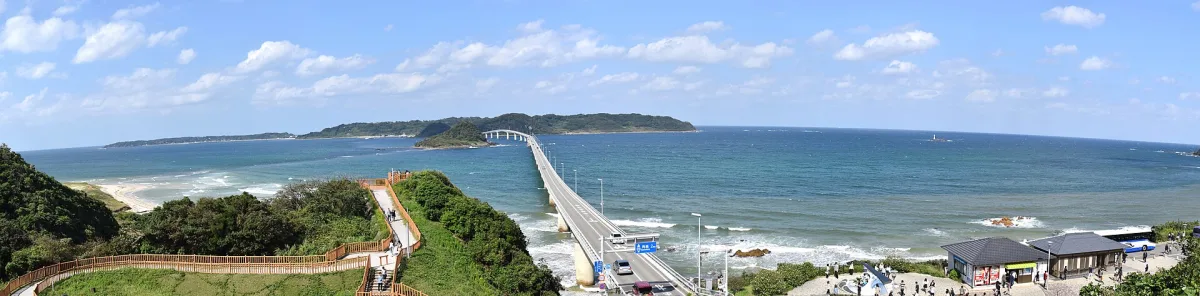
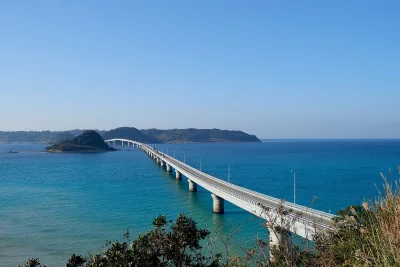 Tsunoshima Bridge Viewpoint
A mainland viewpoint over the 1,780m Tsunoshima Bridge as it crosses cobalt-blue sea to Tsunoshima island. You can drive across the bridge for free.
Tsunoshima Bridge Viewpoint
A mainland viewpoint over the 1,780m Tsunoshima Bridge as it crosses cobalt-blue sea to Tsunoshima island. You can drive across the bridge for free.
.jpg)

Sea on three sides, limestone at the centre
Yamaguchi occupies the western end of Honshu, Japan's main island. To the south it meets the Seto Inland Sea, while its northern coast faces the Sea of Japan and shows a different, wilder face. Mountains run through the interior, so a trip across the prefecture feels less like following one coastline and more like moving between different landscapes. Shimonoseki faces the Kanmon Strait, with Kyushu on the other side. Further east in Iwakuni, the five-arched Kintaikyo Bridge spans the Nishiki River.
Inland, Akiyoshidai is a grassland dotted with pale limestone. It is a karst landscape, where rainwater has slowly dissolved the rock over a long time, creating distinctive shapes both on the surface and underground. This limestone began as coral reefs in the sea hundreds of millions of years ago. Beneath the plateau lies Akiyoshido, a huge cave with flowing water, stone terraces (rimstone pools that look like terraced rice fields) and towering formations. Walking the open plateau and going into the cave show you two sides of the same geological story.
Hagi, and the people who changed Japan
Hagi was the centre of a han (a domain ruled by a samurai lord before the modern prefectures existed). The castle is now only a ruin, but the town layout survives. You can still walk past old walls and residences with natsumikan (summer orange) trees rising above them. The castle town district is one of the component parts of a UNESCO World Heritage Site related to Japan's early industrialisation.
Choshu (the old name for the domain) also played a central role in the Meiji Restoration, the 19th-century political transformation that ended rule by the shogunate and helped establish modern Japan. Yoshida Shoin and Takasugi Shinsaku were figures from Choshu. In Hagi, the former Shoka Sonjuku school and industrial heritage sites place those ambitions within a town small enough to explore on foot. History here is not just a collection of monuments: it lives in the short distances between the old classroom, the workshops and the streets of samurai houses.
Fish, hot tiles and pottery for tea
Shimonoseki is closely associated with fugu (blowfish). It arrives as thin, delicate slices carefully arranged on the plate, and it is a dish best left to licensed chefs, because parts of the fugu are poisonous. Around Karato Market, the seafood culture goes well beyond this one speciality. Yamaguchi's coastline, with sea on three sides, also explains why fish looms so large in the prefecture's food.
For a completely different meal, try kawara soba: green tea soba served on a heated kawara (roof tile), usually topped with beef, thin strips of egg, spring onion and the like. Yamaguchi's uiro is a soft steamed sweet made from bracken starch. In Hagi, look beyond edible souvenirs to Hagi-yaki, the town's pottery tradition. Its understated shapes and subtly changing glazes have long attracted people who practise the tea ceremony. A bowl used for tea is a more personal way into this craft than seeing it in a display case.
A local accent, even in the welcome
One word travellers are likely to see is "oidemase", the local way of saying "welcome", which appears on signs and in the prefecture's tourism greetings. Yamaguchi speech has other recognisable phrases too: "buchi" means "very", and verb endings such as "-choru" give everyday conversation a regional ring. According to the local tourism association, the way people speak also varies from area to area within the prefecture.
Another small language clue is on the table: locals sometimes call fugu "fuku" rather than the standard "fugu", a sound that also calls to mind fuku, the Japanese word for good fortune. Regional character goes beyond words. In Hagi, pottery shops are still part of the townscape, and the link between local tableware and tea connects a living craft to everyday hospitality. Even without speaking Japanese, you will notice how often Yamaguchi expresses its welcome through words, food and things made close to home.
A year around the coasts and hills
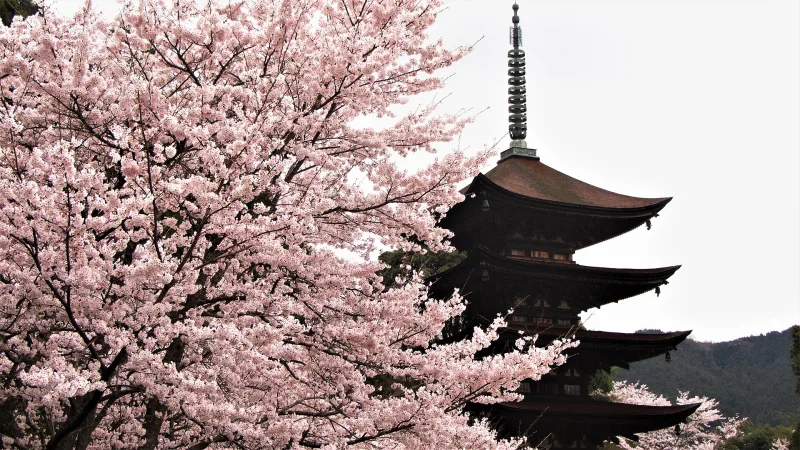
In spring, cherry blossoms bloom at Hagi's castle ruins and around Kintaikyo Bridge. Summer puts the coast in the spotlight: Hagi's Kikugahama beach lies near the old castle town, and Akiyoshido offers a cool underground world in contrast to the open plateau above. In autumn, maple leaves add colour around Toko-ji temple in Hagi and Kikko Park in Iwakuni.
The plateau has its own seasonal rhythm. Winter is a good season for hot kawara soba and for onsen (Japanese hot springs). Yuda Onsen in Yamaguchi City has footbaths where you can take a break between walks.
Once you arrive, choose a region
The Sanyo Shinkansen, one of Japan's high-speed rail lines, links Yamaguchi with cities to the east and with Fukuoka to the west. Shin-Yamaguchi is a convenient arrival point for Hagi and the interior, and Shin-Shimonoseki is the gateway to the southwestern tip. Flying into Yamaguchi Ube Airport is another option.
Once you are there, think region by region rather than trying to see the whole prefecture from one base. Buses link Shin-Yamaguchi and Hagi, and Akiyoshido can also be reached by bus from Yamaguchi City and other parts of the prefecture. Hagi's old streets are enjoyable on foot or by bicycle once you arrive. For a trip linking several coastal and inland places far apart from each other, a car gives you more freedom in choosing your route. If you are using public transport, group nearby sights together and check connections before you set off.
Sources
- Introduction of Yamaguchi Prefecture - Yamaguchi Prefecture
- Things to do in Yamaguchi Prefecture・in English - Introduction of Yamaguchi Prefecture - Yamaguchi Prefecture
- Yamaguchi | Chugoku | Destinations | Travel Japan - Japan National Tourism Organization (Official Site)
- Akiyoshidai Plateau | Travel Japan - Japan National Tourism Organization (Official Site)
- Hagi | Yamaguchi | Chugoku | Destinations | Travel Japan - Japan National Tourism Organization (Official Site)
- Hagi Castle Town | Travel Japan - Japan National Tourism Organization (Official Site)
- 山口の方言をマスターしよう!山口弁の使い方|特集|【公式】山口県観光/旅行サイト おいでませ山口へ