Nagasaki
Nagasaki combines island coastlines with a port-city history shaped by trade, faith and peace, links that still live on in its food and festivals.
Map outlines: Natural Earth
-
1
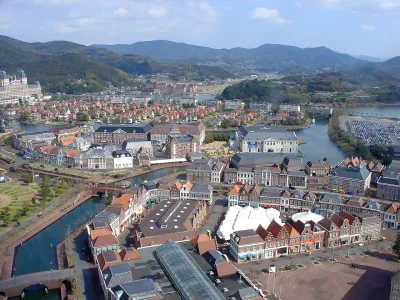 Huis Ten Bosch
A huge theme park on Omura Bay in Sasebo, Nagasaki, recreating a Dutch town, canals and all, that changes from spring tulips to winter illuminations.
Huis Ten Bosch
A huge theme park on Omura Bay in Sasebo, Nagasaki, recreating a Dutch town, canals and all, that changes from spring tulips to winter illuminations.
-
2
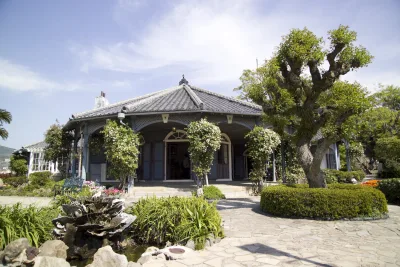 Glover Garden
Nine late Edo and Meiji-era Western houses on a hill above Nagasaki Port, including the World Heritage Former Glover House, Japan's oldest wooden Western-style house.
Glover Garden
Nine late Edo and Meiji-era Western houses on a hill above Nagasaki Port, including the World Heritage Former Glover House, Japan's oldest wooden Western-style house.
-
3
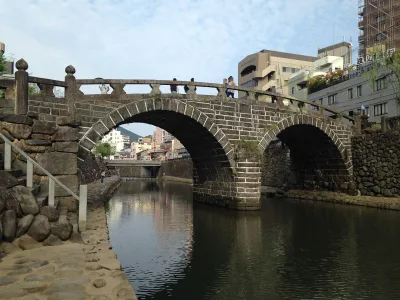 Meganebashi Bridge (Spectacles Bridge)
A stone arch bridge over Nagasaki's Nakashima River, built in 1634. Its two arches reflected in the water look like a pair of glasses, hence its name.
Meganebashi Bridge (Spectacles Bridge)
A stone arch bridge over Nagasaki's Nakashima River, built in 1634. Its two arches reflected in the water look like a pair of glasses, hence its name.

A prefecture drawn by the sea
Nagasaki Prefecture is on the western side of Kyushu, but its map makes most sense if you look at the sea first. Peninsulas reach out into the water, and more than 1,400 islands belong to the prefecture. That geography gives each place its own character. Nagasaki city climbs the hills around its harbour, Sasebo faces the crowded little islands of Kujukushima, and further west lie the Goto Islands, with their sandy beaches, fishing villages and churches.
The inland contrast is Unzen on the Shimabara Peninsula. Near the hot-spring town, white steam rises from volcanic vents, and the surrounding mountains change their look dramatically through the year. Iki and Tsushima also belong to Nagasaki Prefecture, though many travellers reach them from Fukuoka. Try to see all of these as side trips from Nagasaki city and you miss the point: crossing the sea, and the long coastline itself, are part of what Nagasaki is.
Trade, hidden faith and a pledge for peace
For centuries, Nagasaki's port connected Japan with people and goods from across Asia and Europe. Even in the Edo period, when contact with the outside world was tightly restricted, Nagasaki remained an officially approved base for foreign trade. You can see that history at Dejima, the former trading post in Nagasaki city, and in its Western-style buildings, but it is not confined to the city. Traces of those exchanges survive in food, crafts and festival performances too.
Another side of the story calls for a quieter visit. When Christianity was banned, believers in the Goto Islands kept their faith in secret, passing prayers down within their communities. The churches later built there preserve that history, and some related sites are registered as a World Heritage Site, the Hidden Christian Sites in the Nagasaki Region. These are places of prayer, not just historic buildings, so visitors need to show respect to the people who worship there.
On 9 August 1945, Nagasaki city was devastated by an atomic bomb. The Peace Park and the Atomic Bomb Museum tell the story of the attack and its aftermath. At the city's annual memorial events, calls for a world without nuclear weapons also continue.
What the port brought to the table
Start with champon: Nagasaki's bowl of noodles, vegetables, pork and seafood in a rich broth. A local Chinese restaurant created it as a nourishing meal for Chinese students. It is not just a special-occasion dish but an everyday way to taste the city's history of exchange. Castella, a soft sponge cake, tells another part of the trade story: sugar that came in through Nagasaki helped the city establish its culture of sweets.
The food changes as you travel. The Goto Islands make Goto udon, a local speciality of thin, springy wheat noodles. Surrounded by fishing grounds, the prefecture puts seafood on tables everywhere. In Sasebo, a local burger tradition grew out of recipes linked to the US Navy in the 1950s. For a souvenir that is not food, look out for Hasami ware, porcelain made in Hasami. Its long history includes not only everyday tableware but also bottles once used to export Japanese sake and soy sauce to Europe.
Every season has its own sound
In spring, azaleas bloom on the mountains of Unzen; in summer, attention turns to the islands, the sea and boat races. In autumn, Nagasaki city holds Kunchi, the annual festival of Suwa Shrine. Neighbourhood groups put on dances and elaborate performances, including the Chinese-influenced dragon dance and festival floats. They also tour the city giving short performances in front of shops and homes to share good fortune. If you hear the crowd shout 'motte koi', they are calling on the group for an encore.
In winter, the Nagasaki Lantern Festival, which grew out of the city's Chinese New Year traditions, fills the streets with lanterns. Unzen offers a different winter scene, with rime ice on the mountains and steam rising near the hot springs. These contrasts are a good reason to think beyond a single photo of the harbour: Nagasaki's seasons are experienced differently in city streets, on volcanic slopes and on island shores.
Once you arrive, choose a direction
Most travellers arrive at Nagasaki Airport or come by rail from Hakata Station in Fukuoka. On the train journey to Nagasaki city, you change at Takeo-Onsen Station from a limited express on the conventional line to the Nishi-Kyushu Shinkansen. There is no direct shinkansen from Hakata to Nagasaki. In the city, trams are handy for reaching the main sights, and buses help with places outside the tram network, such as Unzen.
If you are heading for the islands, first decide which ones you want to explore. Boats run from Nagasaki Port to various parts of the Goto Islands, while boats to Iki and Tsushima leave from Hakata Port, and some islands are also linked by air with Nagasaki or Fukuoka. On the Goto Islands, a hire car makes it easy to reach scattered sights, but getting from island to island needs separate planning. Build in enough slack for this geography. A trip centred on Nagasaki city and one centred on Goto may not share a single stop, yet both can feel thoroughly Nagasaki.
Sources
- Everything you need to know for your first Nagasaki trip: Where to go, what to eat, access information, and more
- Nagasaki | Kyushu | Destinations | Travel Japan - Japan National Tourism Organization (Official Site)
- Learn about Goto Islands!
- Unzen Onsen
- Visiting Goto’s churches, built by the hidden Christians
- Praying for peace in Nagasaki in 2025, 80 years since the dropping of the atomic bomb
- Experience Nagasaki's culture - 10 festivals in Nagasaki City that can be enjoyed all year round.
- ミニ辞典| 長崎くんち <長崎伝統芸能振興会>
- Crafts and Products in Nagasaki Prefecture
- Relay KAMOME|JR KYUSHU RAILWAY COMPANY
- Access to the Outer Islands