Nijo Castle
元離宮二条城
The Tokugawa shoguns' Kyoto castle, witness to both the start and end of their rule. Its Ninomaru Palace is the last palace complex left in any Japanese castle.
The castle that saw the shogunate begin and end
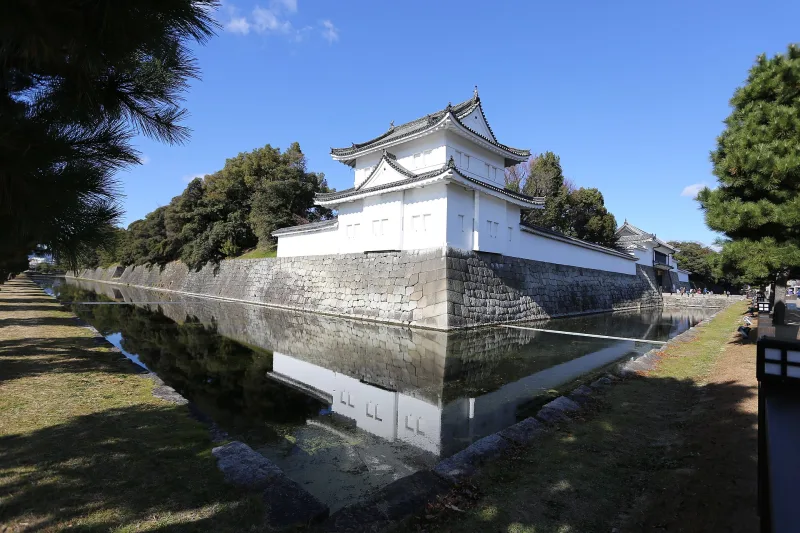
Nijo Castle stands in the centre of Kyoto. Tokugawa Ieyasu, who founded the Edo shogunate (the government of military rulers that ran Japan until 1867), completed it in 1603 as his base in the city. He moved in right after being appointed seii taishogun (shogun, the highest rank a samurai could hold) and celebrated his appointment here.
In 1626, under the third shogun, Iemitsu, the castle welcomed Emperor Go-Mizunoo as a guest. For that visit it was enlarged to the size you see today, and a main keep and a Honmaru Palace were built. The keep and the original Honmaru Palace were later lost to fire, but the Ninomaru Palace still shows how the castle looked at the time.
In 1867 the fifteenth shogun, Tokugawa Yoshinobu, gathered senior retainers from the domains in the Ohiroma (Grand Hall) of the Ninomaru Palace and told them he would return power to the imperial court. This event, the Taisei Hokan (Restoration of Imperial Rule), led to the end of the Edo shogunate. In the Meiji era the castle became a detached imperial villa, which is where its official name, Moto-Rikyu Nijo-jo (Former Imperial Villa Nijo Castle), comes from. In 1994 it was listed as a World Heritage Site as part of the Historic Monuments of Ancient Kyoto.
The Ninomaru Palace, a National Treasure
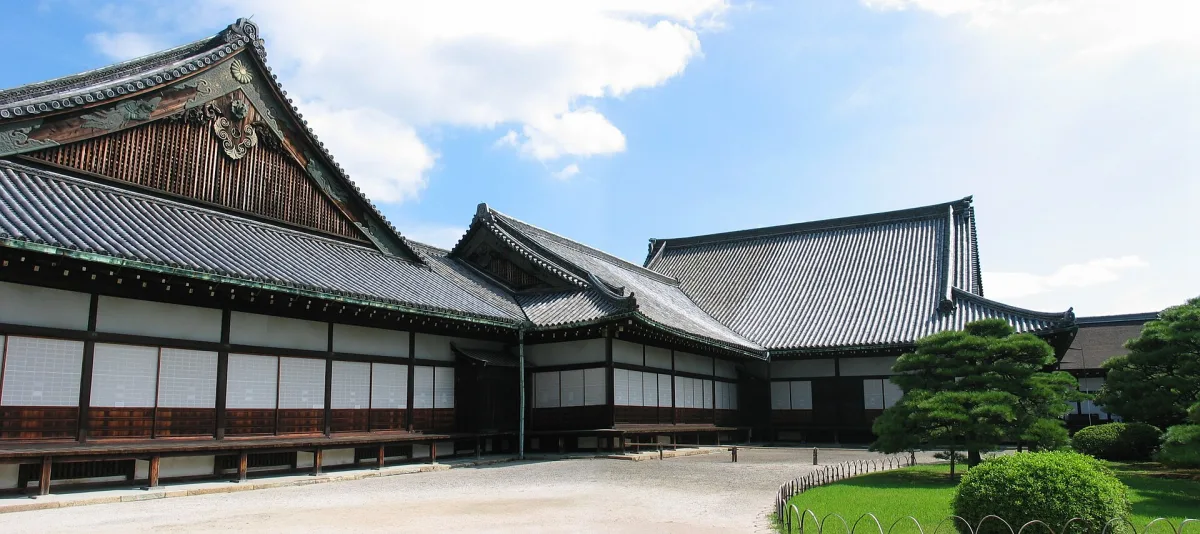
The Ninomaru Palace is made up of six connected buildings and is a leading example of shoin-zukuri, the style of samurai residence of the early Edo period. With the palaces of Edo Castle, Osaka Castle and Nagoya Castle all gone, it is the only palace complex surviving in any Japanese castle, and it is designated a National Treasure.
Inside, the rooms are decorated with paintings on sliding doors and walls by the Kano school, Japan's largest group of painters, along with finely carved ranma (decorative panels above the doorways between rooms) and ornamental metal fittings. The first building you enter, the Tozamurai, is also called the Tiger Room after the tigers painted on its walls and doors, which are thought to have impressed visiting feudal lords with the power of the shogun's family. In the Ohiroma, where the return of power was announced, you can see the raised upper section where the shogun sat.
Outside the palace lies the Ninomaru Garden, designated a Special Place of Scenic Beauty by the national government.
The Honmaru Palace, open again after 18 years
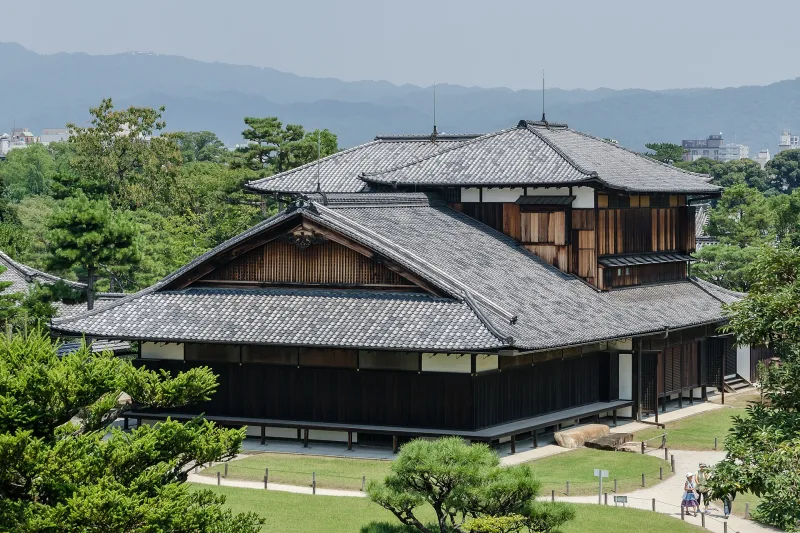
The present Honmaru Palace, in the honmaru (the castle's central enclosure), was originally part of the residence of the Katsura-no-miya, a branch of the imperial family, near the Kyoto Imperial Palace. It was moved here in the Meiji era. It is the only large residence of an imperial branch family dating back to the Edo period that still survives, and it is an Important Cultural Property.
After major repairs it opened to the public in September 2024, for the first time in 18 years. The highlights are paintings from the final years of the shogunate showing seasonal flowers and cranes. Visits to the Honmaru Palace must be booked in advance, and you need a web ticket.
Getting there and how long to allow
The castle is right outside Nijojo-mae Station on the Kyoto Municipal Subway Tozai Line. From Kyoto Station you can get there by subway or city bus. The castle asks visitors to come by public transport.
From the entrance at the Higashi-Otemon Gate to the Honmaru Palace is about 850 m, which takes at least 15 to 20 minutes. The official website suggests allowing about 30 minutes to see the Ninomaru Palace. Check the official website for opening hours, closing days and admission fees.
Tips
- If you want to see the Honmaru Palace, book a web ticket on the official website. Tickets go on sale 30 days before your visit, and only a small number are sold on the day. Visitors are asked to enter the castle at least 20 minutes before their booked time.
- If you have a one-day subway pass or a one-day subway and bus pass, you get a discount on admission on the day the pass is valid.
- To protect its paintings, the Otsune Goten (the living quarters of the Honmaru Palace) opens its rooms in rotation at different times of year, and the Ninomaru Palace also has days when it is closed to visitors. Check the viewing schedule on the official website before you book.
Sources
- 歴史|世界遺産・元離宮二条城
- 二の丸御殿・庭園|世界遺産・元離宮二条城
- 本丸御殿・庭園|世界遺産・元離宮二条城
- 本丸御殿の観覧について|世界遺産・元離宮二条城
- 交通アクセス|世界遺産・元離宮二条城
- 二条城 - Wikipedia
Updated 29 September 2026. Opening hours and prices change, so check the official site before you go.


.jpg)