Kenroku-en Garden
兼六園
One of Japan's three great gardens, shaped over generations by the lords of Kaga. Stroll past ponds, hills and teahouses that change with every season.
A lord's garden nurtured by generations of the Kaga clan
Kenroku-en Garden is in the centre of Kanazawa, Ishikawa Prefecture. Together with Kairaku-en in Mito and Koraku-en in Okayama, it is counted as one of the Three Great Gardens of Japan, and it is designated a Special Place of Scenic Beauty, the highest rank the national government gives to cultural properties for the beauty of their scenery.
It is said to have begun in 1676, when Maeda Tsunanori, the fifth lord of the Kaga domain (the domain of the Maeda family, which ruled the provinces of Kaga, Noto and Etchu), built a villa on the slope facing Kanazawa Castle and laid out a garden around it. Later lords kept adding to it, and it took roughly its present form under the 13th lord, Nariyasu.
It was opened to the public in 1874 (the 7th year of the Meiji era), and today it is loved by locals and visitors from all over the world alike.
Where the name comes from: the "six attributes"
The name Kenroku-en comes from the rokusho, or six attributes, described in Luoyang Mingyuan Ji (Record of the Famous Gardens of Luoyang), a book from China's Song dynasty. They are six qualities of a landscape: spaciousness and seclusion (a quiet, secluded depth), human artifice and antiquity (a weathered, aged feel), and water features (ponds, waterfalls and streams) and broad views.
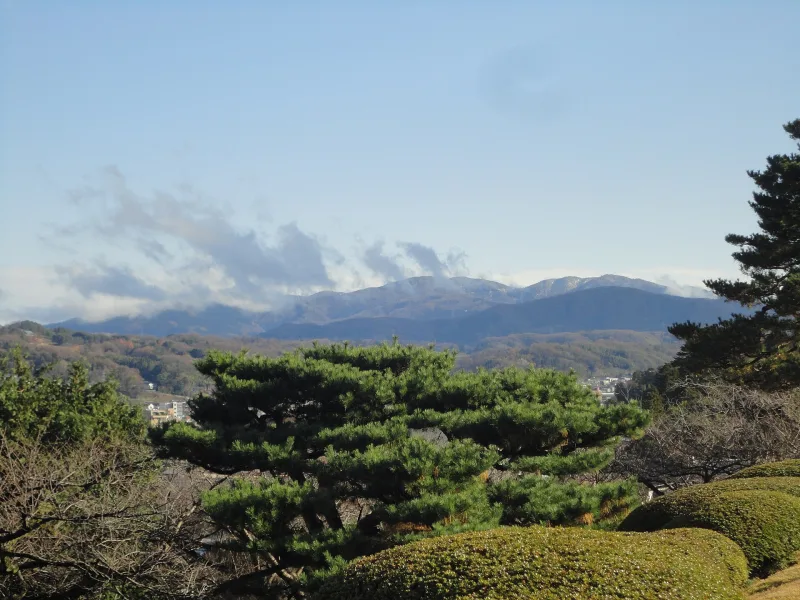
These six are said to be hard to achieve together, and in 1822 the garden was named Kenroku-en, "the garden that combines the six", because it has all of them. As you enjoy the flowing water inside the garden, you can also look out to distant mountains such as Mount Utatsu and Mount Io.
Highlights to enjoy on foot
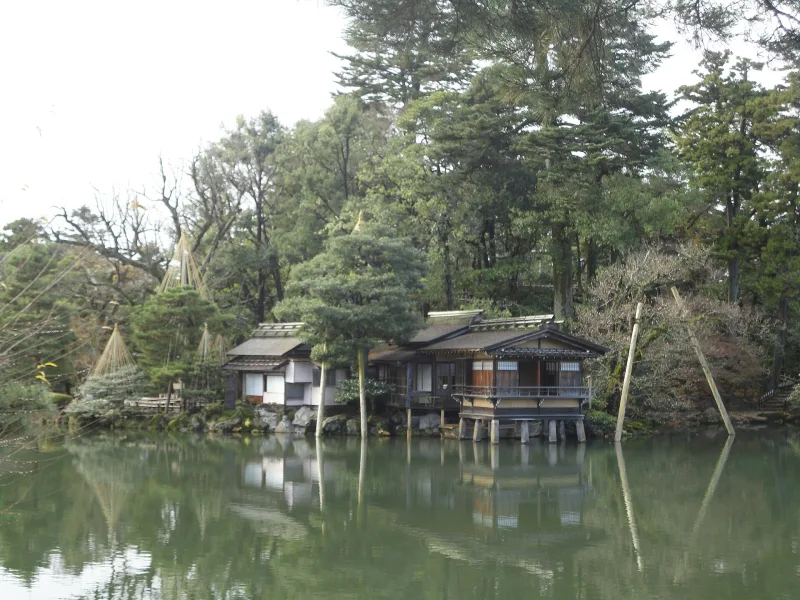
Kenroku-en is a kaiyu-style (strolling) garden. Rather than being viewed from inside a room, it is designed to be enjoyed as a whole by walking around it, past a large pond, tsukiyama (small artificial hills made from heaped-up earth), teahouses and more.
Its most famous view is the Kotoji-toro lantern on the shore of Kasumiga-ike Pond. This stone lantern has two legs of different lengths and is named after the kotoji, the bridge that holds up the strings of a koto (a Japanese harp), which it resembles. Near the pond is the Karasaki Pine, a celebrated tree.
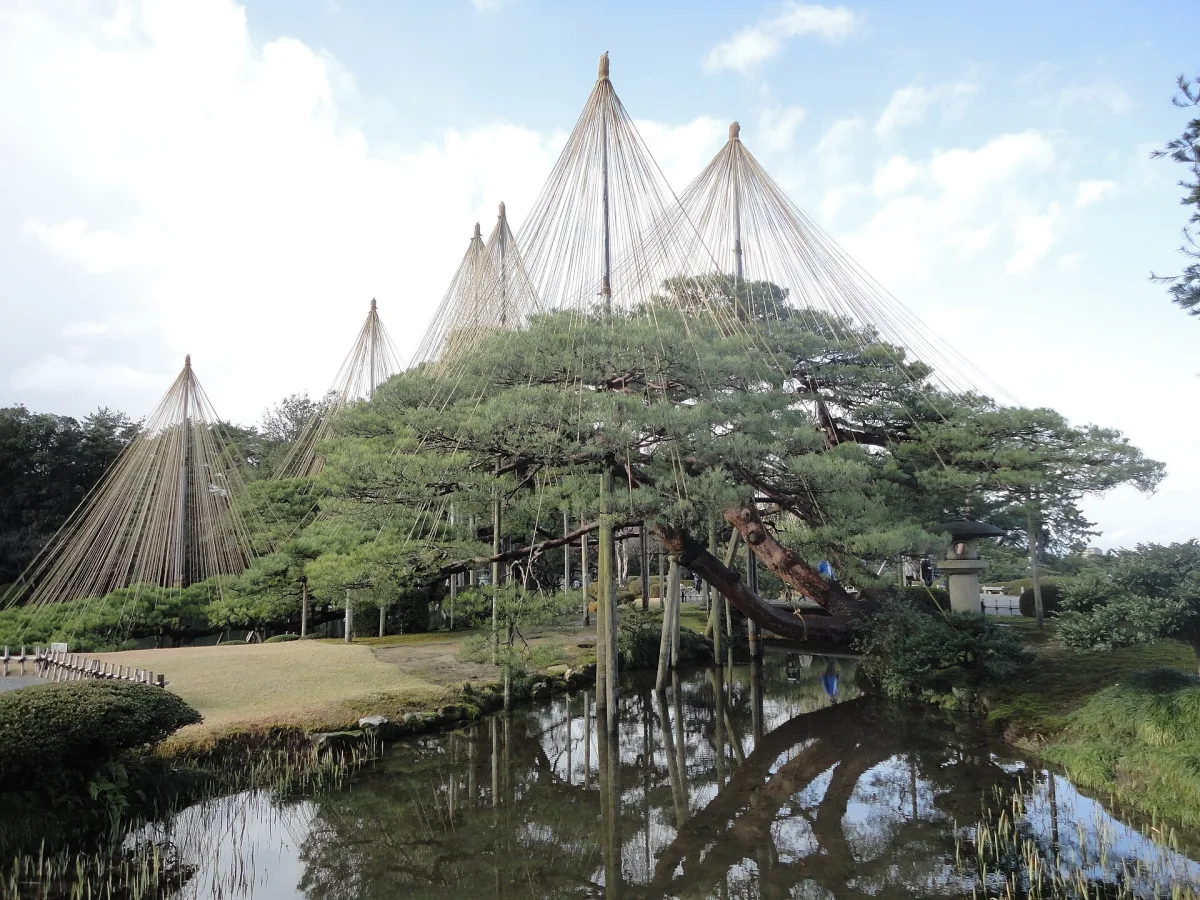
In winter, trees such as the Karasaki Pine are given yukitsuri ("snow hanging"), in which ropes are strung in a cone from the top of a pole, and this is known as Kenroku-en's signature winter scene. The garden also has a fountain that shoots water up using only natural water pressure, said to be the oldest surviving fountain in Japan.
Getting there and when to go
From Kanazawa Station, take a local bus for about 12 minutes to the Kenrokuen-shita / Kanazawa-jo stop, then walk about five minutes to the Katsurazaka Entrance. Kanazawa Castle Park is right next door, so you can visit both together.
Opening hours change with the season, and there is an early-morning period when entry is free (only some entrances are open then). The garden is sometimes lit up during the cherry blossom and autumn leaves seasons. Check the official website for the latest information.
Tips
- To avoid the crowds, try the free early-morning opening. Note that at that time you can only enter through the Renchimon Entrance and the Zuijinzaka Entrance.
- Kanazawa Castle Park is right next door, and you can walk to the entrances of both from the same bus stop, Kenrokuen-shita / Kanazawa-jo. Plan to visit them one after the other to save time.
- There are slopes, so wear comfortable shoes. Wheelchairs are available to borrow, and the area around the Kodatsuno Entrance is relatively flat.
Sources
Updated 28 September 2026. Opening hours and prices change, so check the official site before you go.

.jpg)
.jpg)
.jpg)