Kanazawa Castle Park
金沢城公園
The grounds of the Maeda clan's Kanazawa Castle: an Edo-period gate, turrets rebuilt in traditional timber, and walls called a "museum of stone walls".
Home of the Maeda family of the Kaga domain
Kanazawa Castle was the seat of the Maeda family of the Kaga domain, which ruled three provinces, Kaga, Noto and Etchu, with lands worth more than a million koku. A koku is a unit that expressed the size of a domain by how much rice it produced.
This spot was originally home to Kanazawa Mido, a temple of the Honganji sect said to have been founded in 1546. In 1583 Maeda Toshiie moved into the castle and began building it up in earnest, with a keep, stone walls and more. The keep burned down after a lightning strike in 1602 and was never rebuilt.
After a great fire in 1631, the third lord, Maeda Toshitsune, moved the heart of the castle to the Ninomaru (second bailey) and built the vast Ninomaru Palace. In the years that followed, the castle was repeatedly destroyed by great fires and rebuilt.
Ishikawa Gate and turrets rebuilt in timber
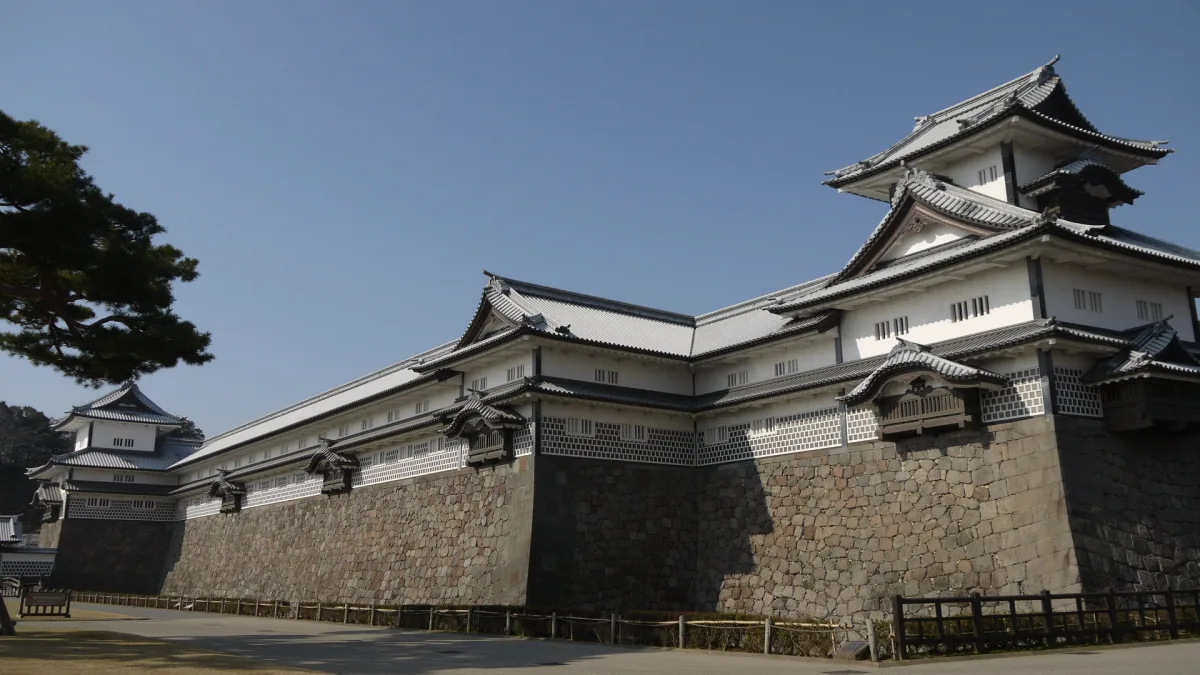
Ishikawa Gate, which stands at the entrance on the Kenroku-en side, was rebuilt in 1788 and is a national Important Cultural Property. It is a masugata-mon, a gate enclosed in a square by gates, walls and yagura (turrets used for keeping watch and defence). Only two sets of buildings of this type are said to survive complete from the Edo period: the Otemon Gate of Osaka Castle and Ishikawa Gate.
The roofs use namarigawara, lead tiles made by laying lead sheets over a wooden base. Lead turns silvery white when exposed to rain, and together with the white shikkui (lime plaster) walls and the namako-kabe walls faced with tiles, it gives Kanazawa Castle its distinctive pale look.
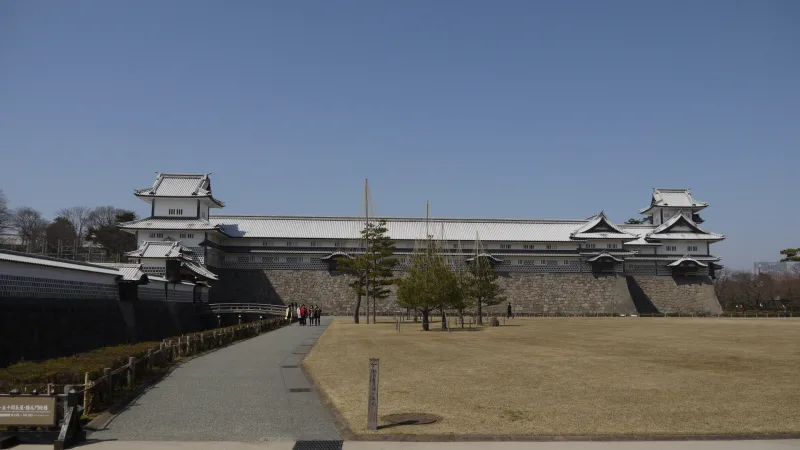
The Hishi Yagura (diamond-shaped turret), Gojikken Nagaya (a long, narrow building) and Hashizume-mon Tsuzuki Yagura (the turret beside Hashizume Gate), which guarded the Ninomaru, burned down in 1881 in a fire accidentally started by the army. In 2001 they were rebuilt using traditional timber construction methods, based on old photographs, drawings and excavations. You can go inside to see how they are built and the craftsmanship that made the reconstruction possible.
A museum of stone walls and Gyokusen-inmaru Garden
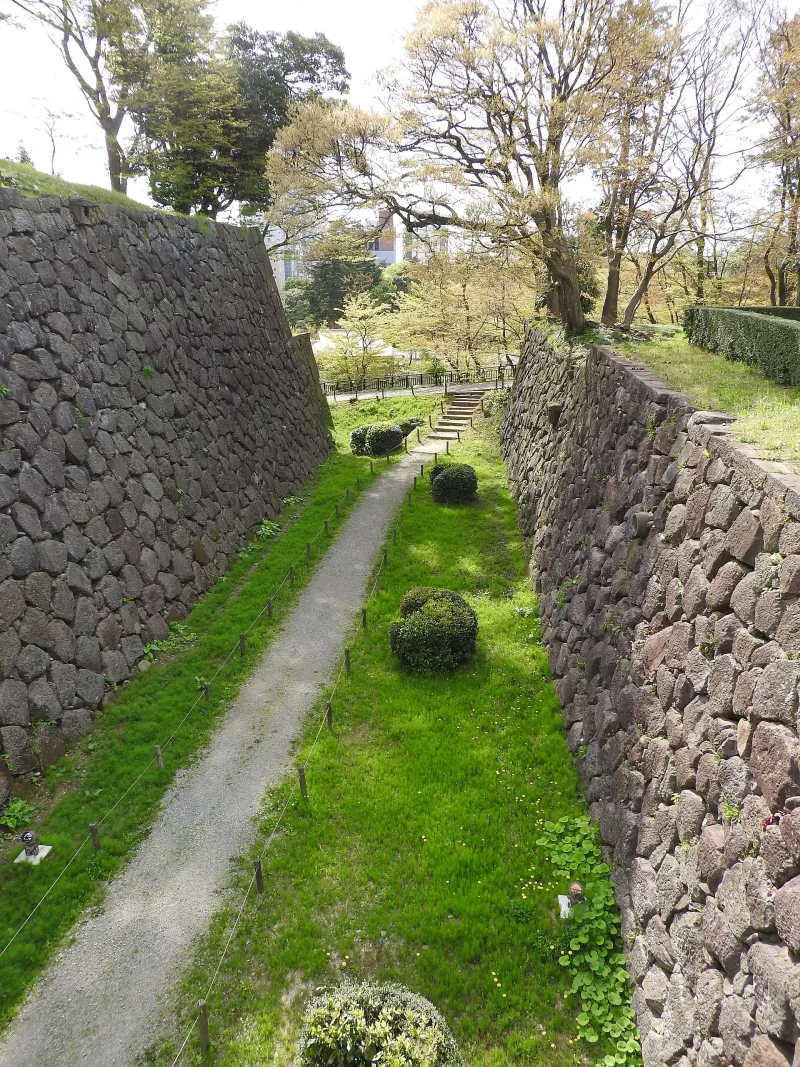
Kanazawa Castle's stone walls are also known as a "museum of stone walls", because you can see a wide range of building techniques from every era since the early Edo period.
Gyokusen-inmaru Garden began when Toshitsune had it made in 1634, and it was very much a private inner garden for the lord. It disappeared in the Meiji era but was recreated in 2015 based on excavations and old drawings. Its shikishi-tanzaku-zumi stone wall, with a waterfall built into the top of the wall, combines castle wall-building techniques with garden design and is unique to Kanazawa Castle.
Recovering from the earthquake and rebuilding the Ninomaru Palace
In the Noto Peninsula Earthquake of 1 January 2024, stone walls in Kanazawa Castle Park collapsed in five places and were deformed in 23. Surveys and repairs are now under way so that the fallen stones can be put back in their original positions. Since July 2025 there has been a viewing route at the Imoribori area, where the stones are being examined and stored.
Work has also begun on rebuilding the Ninomaru Palace, where the lord lived and governed. A groundbreaking ceremony was held in March 2025, and if all goes to plan, the first phase, covering the entrance hall and the shikidai (the room where guests were received), is due to be finished around fiscal year 2033.
Getting there
The park has five entrances, and the nearest bus stop depends on which one you use. For the Ishikawa-mon Entrance, take a local bus from Kanazawa Station to the Kenrokuen-shita / Kanazawa-jo stop and walk about five minutes. Kenroku-en is right next door, so you can visit both one after the other. Check the official website for opening hours and admission fees for the buildings.
Tips
- The park itself opens early in the morning, and there are times when you can walk around it for free. To go inside buildings such as the Hishi Yagura and Gojikken Nagaya, you need to pay a separate admission fee.
- If you are combining your visit with Kenroku-en, the Ishikawa-mon Entrance is the most convenient way in, as Ishikawa Gate faces the Kenroku-en side.
- On some days the park opens at night or is lit up. Check the dates on the night opening and illumination page of the official website.
Sources
- 金沢城公園 公式サイト(石川県金沢城・兼六園管理事務所)
- 金沢城の歴史 | 金沢城公園
- 石川門 | 金沢城公園
- 菱櫓・五十間長屋・橋爪門続櫓 | 金沢城公園
- 鉛瓦の技 | 金沢城公園
- 漆喰壁、海鼠壁の技 | 金沢城公園
- 玉泉院丸庭園、玉泉庵 | 金沢城公園
- 石垣の復旧 | 金沢城公園
- 二の丸御殿の復元整備 | 金沢城公園
- アクセス | 金沢城公園
Updated 28 September 2026. Opening hours and prices change, so check the official site before you go.