Hiroshima Peace Memorial Park
平和記念公園
A park for peace, built on a district destroyed by the atomic bomb on 6 August 1945. Visit the Dome, memorials and museum to see what happened here.
A park built over a former downtown
The Peace Memorial Park is in central Hiroshima, on the delta where the Motoyasu River branches off from the Ota River. From the Edo period to the early Showa era, this was Hiroshima's main shopping area: a densely packed neighbourhood of homes and shops known as the Nakajima district. The atomic bomb of 6 August 1945 destroyed it.
After the war, in 1949, the Hiroshima Peace Memorial City Construction Law was passed, and in a design competition that same year the plan by a team including the architect Tange Kenzo won first place. Work started in 1950, and the park was completed in 1954. In 2007 it was also designated a national Place of Scenic Beauty (a cultural property the national government designates for outstanding scenery).
An axis running straight to the Atomic Bomb Dome
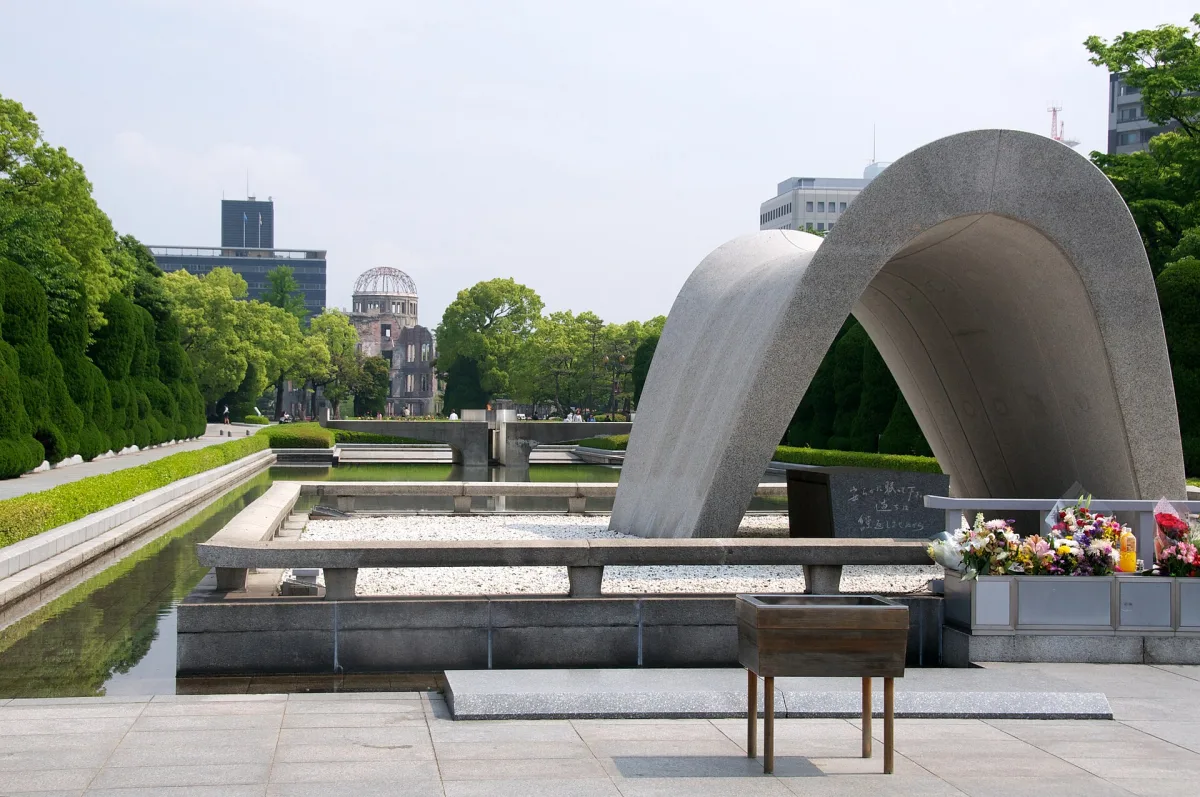
The most important idea in the park's design is an axis running in a straight line from Peace Boulevard in the south, through the arch of the Memorial Cenotaph for the A-bomb Victims, to the Atomic Bomb Dome across the river. It is laid out so that when you stand in front of the cenotaph, you see the Dome framed beyond the arch.
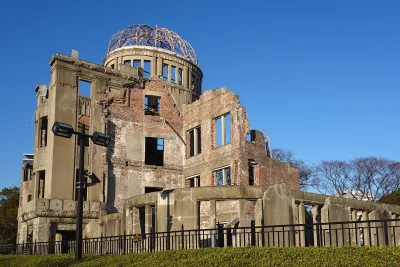
The Atomic Bomb Dome was originally the Hiroshima Prefectural Commercial Exhibition Hall, a Western-style building completed in 1915 and designed by the Czech architect Jan Letzel. Left as a bare skeleton by the bombing, it was inscribed as a UNESCO World Heritage site in 1996.
The cenotaph, the Flame of Peace and the Children's Peace Monument
The Memorial Cenotaph for the A-bomb Victims was built in 1952. It is shaped like a haniwa (the unglazed clay figures of the Kofun period). It holds the register of names of those who died from the atomic bomb, and it is carved with the words "Let all the souls here rest in peace, for we shall not repeat the evil."
The Flame of Peace was lit in 1964 and keeps burning in the hope that nuclear weapons will be abolished. It combines flames sent from temples, factories and other places all over Japan. The Children's Peace Monument was built in 1958 with donations from children across Japan, inspired by the story of Sasaki Sadako, a girl exposed to the bomb; it shows a girl holding up a golden paper crane. There is also the Peace Bell, whose surface is engraved with a map of the world without borders.
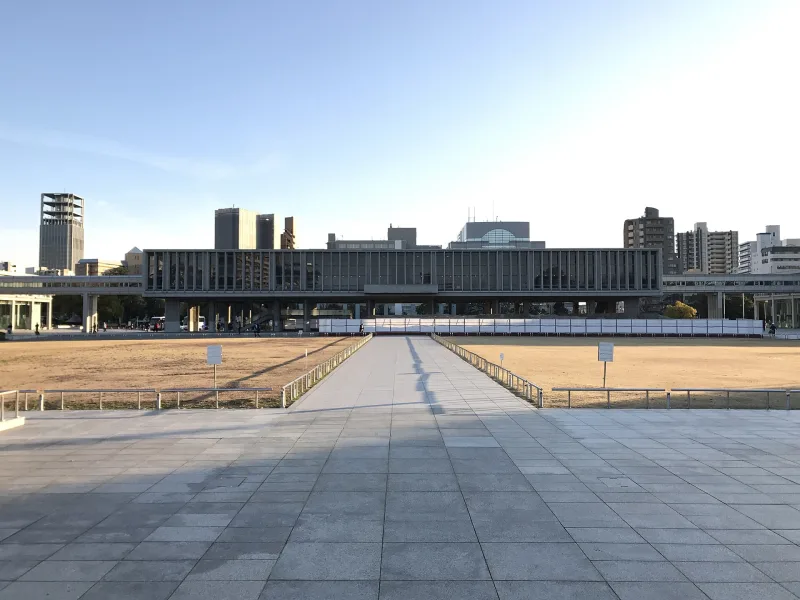
Inside the park is the Hiroshima Peace Memorial Museum (completed in 1955), which displays material conveying the damage caused by the atomic bomb.
Getting there and when to visit
The park is about 2 km from JR Hiroshima Station. On the Hiroden (Hiroshima Electric Railway) tram, get off at the Genbaku Dome-mae stop and you are right at the Atomic Bomb Dome; you can also walk from the Hondori and Fukuromachi stops. Buses and Hondori Station on the Astram Line (an automated transit line) are other options. Tram route numbers can change, so check the destination before you board.
Every year on 6 August, the Peace Memorial Ceremony is held, and many people gather to mourn the victims.
Tips
- If you want to take your time at the Peace Memorial Museum, leave plenty of time. Opening hours and how to get in vary by season and period, so check the official website.
- The museum sometimes closes temporarily, for example to change its exhibits. Closures have been announced for 2026 as well, so check the notices on the official website before making plans.
- The park has no car park of its own. The tram or bus is the easiest way to get there.
Sources
- 原爆関係の慰霊碑等の概要|広島市公式ウェブサイト
- 平和記念公園 - 文化遺産オンライン(文化庁)
- Hiroshima Peace Memorial (UNESCO) | Travel Japan (JNTO)
- Q: Tell me the access to the Peace Memorial Park | Dive! Hiroshima
- 広島平和記念資料館 | お知らせ一覧
Updated 28 September 2026. Opening hours and prices change, so check the official site before you go.
_(2).jpg)
