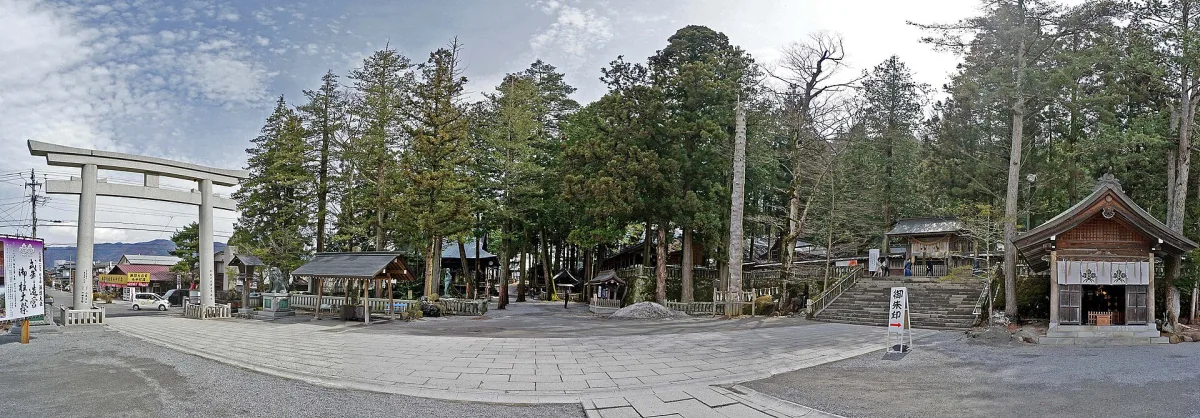
Suwa Taisha Kamisha Honmiya
諏訪大社 上社 本宮
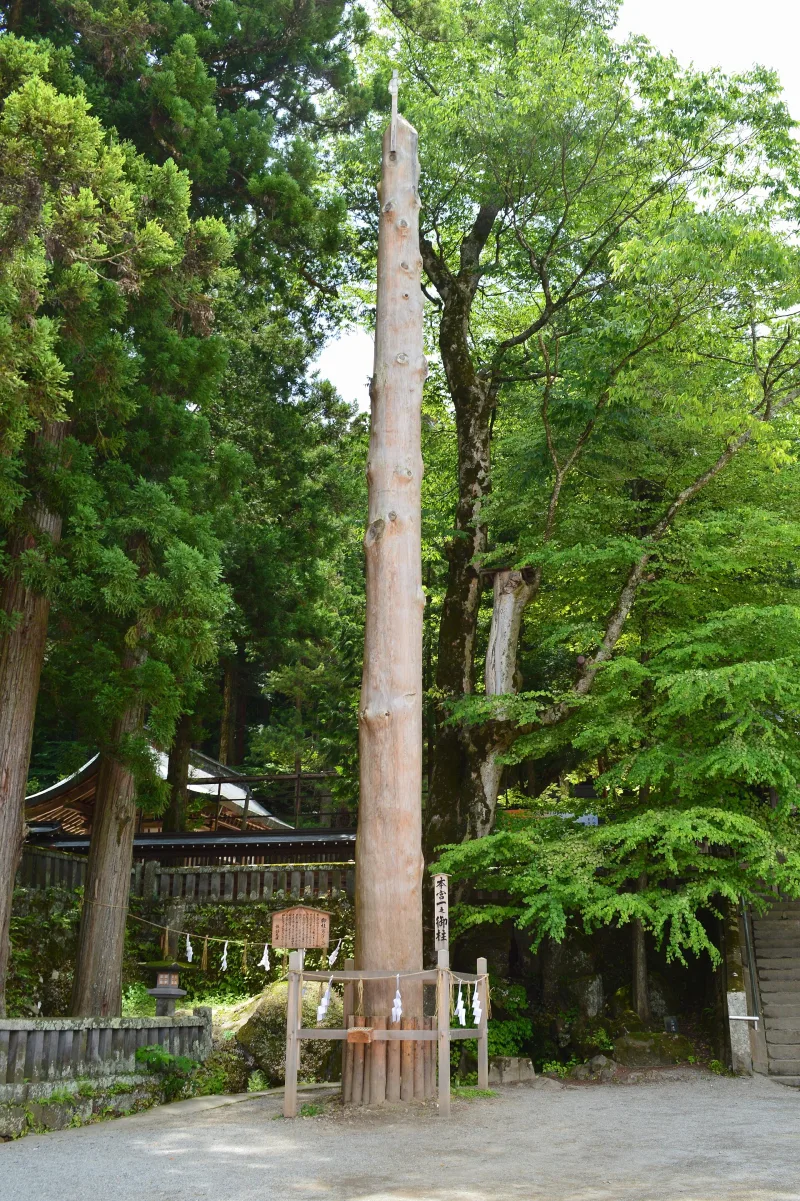
The central shrine of ancient Suwa Taisha. It has no main hall, keeping the old custom of worshipping a mountain; giant onbashira pillars mark its corners.
One of four shrines around Lake Suwa
Suwa Taisha is a Shinto shrine around Lake Suwa in Nagano Prefecture, and the "Shinano no Kuni Ichinomiya", the highest-ranking shrine of the old Shinano Province (today's Nagano Prefecture). It is made up of four shrines: the Honmiya and Maemiya of the Kamisha (Upper Shrine), and the Harumiya and Akimiya of the Shimosha (Lower Shrine).
The Kamisha Honmiya is in Suwa City and honours the god Takeminakata-no-Kami.
A shrine without a main hall
Most shrines have a honden, a main hall where the deity dwells, but the Kamisha Honmiya does not. This is because it keeps an ancient form of worship in which Mount Moriya behind it is revered as a shintaizan (a mountain regarded as the deity itself).
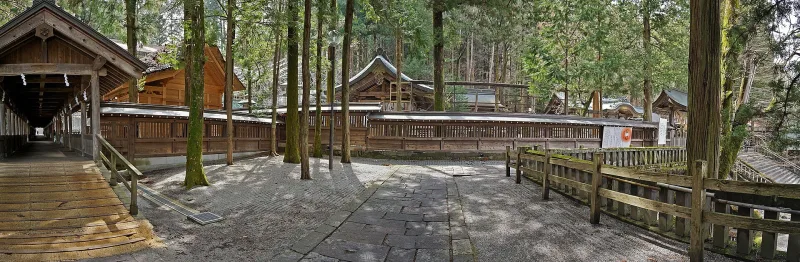
So in place of the main hall that would normally stand behind the worship hall, there is a distinctive layout called Suwa-zukuri: the Heihaiden (offering and worship hall) flanked by two side worship halls, all in a row. The Heihaiden, the Kaguraden (sacred dance hall), the Chokushiden (hall for imperial envoys) and other buildings are national Important Cultural Properties.
The oldest building in the grounds is the Shikyakumon (four-legged gate), which tradition says was built in 1608 on the orders of Tokugawa Ieyasu, who had his retainers erect it as a prayer for peace in the country. The Nunobashi, a covered corridor about 70 m long, was once a passage only high-ranking priests were allowed to use.
The onbashira and the Onbashira Festival
At the four corners of the grounds stand onbashira ("sacred pillars"), huge trunks of fir. They are replaced with new ones at the Onbashira Festival, held in the years of the Tiger and the Monkey in the Chinese zodiac, that is, every six years (traditionally described as "once every seven years" because of the old way of counting that includes the starting year).
The festival is famous for its kiotoshi, when huge firs cut from the mountains are hauled by human strength and sent sliding down a steep slope. It was last held in 2022, and the next one is scheduled for 2028.
Getting there, and visiting all four shrines
The Kamisha Honmiya is about 6 km south-east of Kami-Suwa Station on the JR Chuo Main Line. Most people go by bus or taxi from Kami-Suwa Station or Chino Station.
Visiting all four shrines, known as "shisha meguri", is popular: collect the goshuin (a stamp and brush calligraphy you receive as proof of your visit) from all four and you get a commemorative gift.
Tips
- The water at the temizuya (the basin where you rinse your hands and mouth before praying) is hot spring water. It is an unusual touch that suits hot-spring Suwa, so do rinse your hands here.
- One onbashira stands at each of the four corners of the grounds, and you can try to find all four as you walk round.
- The Kamisha Maemiya is close to the Honmiya and easy to combine with it. The Maemiya is said to be the only one of the shrines where you can see all four onbashira up close.
Sources
- 諏訪大社上社本宮 - 信濃國一之宮 諏訪大社(公式)
- 諏訪大社 四社めぐり | 諏訪観光ナビ
- 諏訪大社上社本宮 四脚門 | 文化遺産オンライン
- 諏訪大社 - Wikipedia
- 御柱祭 - Wikipedia
Updated 29 September 2026. Opening hours and prices change, so check the official site before you go.
.jpg)

.jpg)