Kibitsu Shrine
吉備津神社
An ancient Okayama shrine whose demon-slaying legend is said to have inspired Momotaro, with a National Treasure main hall and a long covered corridor.
The shrine said to be the root of the Momotaro legend
Kibitsu Shrine stands in Kibitsu, Kita Ward, Okayama City. It has long been regarded as the ichinomiya, the highest-ranking shrine, of the old province of Bitchu (today's western Okayama Prefecture). Its principal deity is Okibitsuhiko no Okami.
The shrine preserves a legend in which Kibitsuhiko, sent by the imperial court, defeated Ura, an oni (demon) who had been tormenting the people of the Kibi region. The shrine presents this story as the original version of Momotaro (Peach Boy), one of Japan's best-known folk tales. In the grounds are places tied to the legend, such as the Okamaden (kettle hall), where Ura's head is said to be buried.
The National Treasure main hall and the long corridor
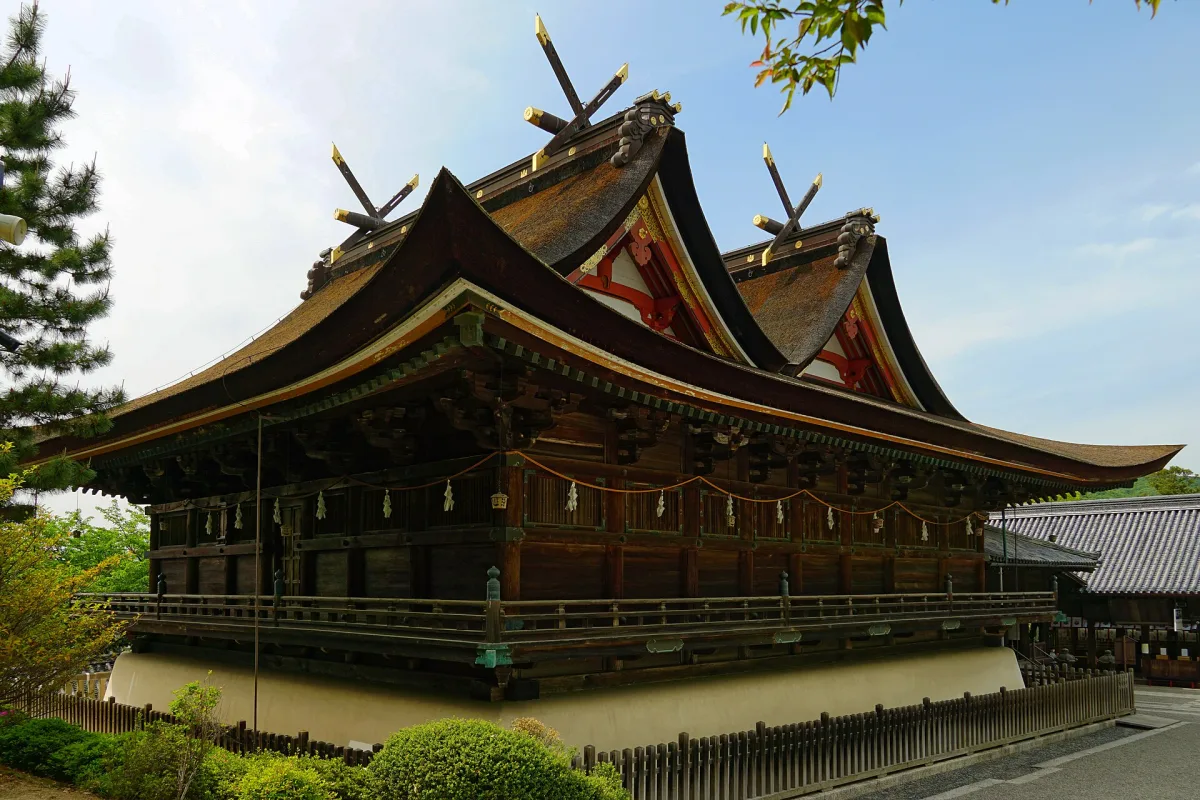
The main hall and the haiden (the hall where worshippers pray) were rebuilt in 1425, in the Muromachi period, and are designated National Treasures. In 2025 they marked 600 years since that rebuilding. The main hall has a unique shape, like two irimoya-style roofs (hipped-and-gabled roofs) set one in front of the other, known as hiyoku irimoya-zukuri or Kibitsu-zukuri. It is said to be the only main hall of this form anywhere in Japan.
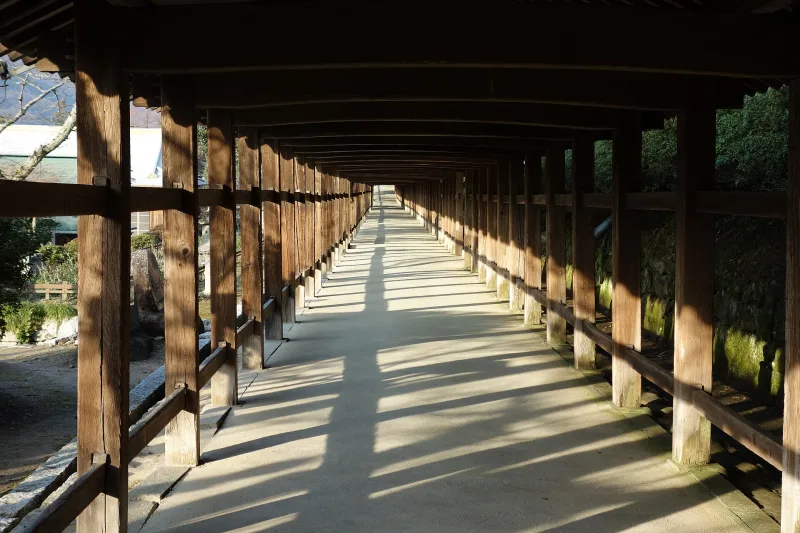
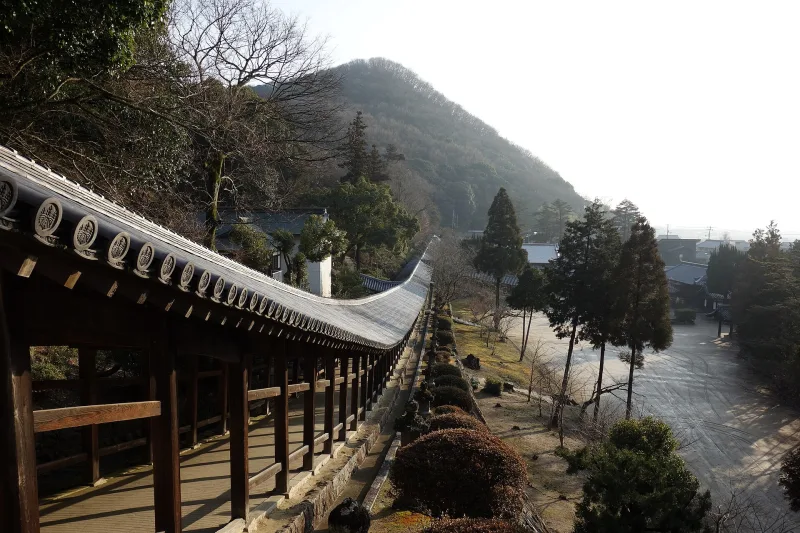
From the main hall, a long roofed corridor, the kairo, runs straight to the south. The corridor is an Important Cultural Property of Okayama Prefecture, and the deep view down its rows of evenly spaced pillars is the shrine's signature sight.
Narukama Shinji: fortune-telling by the sound of a kettle
Kibitsu Shrine is also known for Narukama Shinji, a ritual that reads good or bad fortune from the sound a kettle makes when it is heated. According to the legend, the defeated Ura declared that he would give warning through the kettle: it would ring richly when good things lay ahead and roar harshly when bad things did. The ritual also appears in The Cauldron of Kibitsu, one of the tales in Ugetsu Monogatari (Tales of Moonlight and Rain), an Edo-period collection of ghost stories.
You can take part in Narukama Shinji by applying, but it is not held on certain days of the week and there are fixed reception hours. If you would like to receive it, check the latest information on the official website.
Getting there and seasonal flowers
The nearest station is Kibitsu Station on the JR Kibi Line (also called the Momotaro Line), about a 10-minute walk away. You can get there by train from Okayama Station or Kurashiki Station.
In the grounds, peonies bloom from late spring into early summer and hydrangeas during the rainy season, and in flower season you can enjoy them together with the corridor. Opening hours may change, so check the official website.
Tips
- After seeing the main hall, walk the corridor all the way to the end. The grounds are large, so comfortable shoes are a good idea.
- Look at the main hall from the side as well as the front: from there you can clearly see the shape of the two roofs side by side.
- If you want to take part in Narukama Shinji, note that it is not held on some days of the week, so check the official website before fixing your plans.
Sources
Updated 29 September 2026. Opening hours and prices change, so check the official site before you go.




.jpg)
.jpg)